
Are You Falling Behind On Intelligent Pharmaceutical Manufacturing?
By Raksha Sharma, Dataintelo

The pharmaceutical industry has been gradually adopting automation, digitalization, and intelligent production for a number of years, but are we entering a new era of adoption? Dataintelo estimates the pharmaceutical manufacturing equipment market was valued at $10 billion in 2025 and is expected to grow to $18.45 billion by 2034, representing a compound annual growth rate of 6.8% between 2026 and 2034. Is your company on this trajectory of adoption in the years ahead, or will you be left behind? Let's take a closer look at the efficiencies gained through various intelligent production opportunities: sensors, closed-loop control, PAT, continuous manufacturing, AI, digital twins, robotics, and MES.
Equipment Economics Moves Beyond Purchase Price
The cost of investing in advanced pharmaceutical equipment does not only apply to the initial capital expenditure. Manufacturers are starting to place importance on many different aspects of this equipment, such as the efficiency of the machines, the level of rejections, and the maintenance costs.
Tablet presses accounted for approximately 28.5% of the share of market revenue in the pharmaceutical manufacturing equipment market.
At a capacity of 1 million tablets in an hour, even a 1% rejection rate means about 10,000 tablets will be rejected. When the rejection level is reduced to 0.2%, there are about 2,000 rejected tablets, meaning the difference is 8,000 tablets in an hour.
The cost of integrated tablet rotary systems is around $2.5 million, while semi-automatic presses are priced at around $200,000. The yearly costs for maintenance, tools, and spare parts account for 15%-25% of the original price of the tools.
These figures show why equipment selection is increasingly connected to process visibility and maintenance performance rather than production speed alone.
Sensors Create Millions Of Process Observations
The pharmaceutical industry is becoming highly data-centric. In tablet presses, there are parameters such as pressure, punch position, machine speed, feeding conditions, and tablet weight. Granulators provide input for parameters such as temperature, pressure, torque, rotor speed, and runtime for the operation.
If each machine can measure 20 parameters every second, every hour it will record 72,000 readings for each parameter. In a shift of 16 hours, each machine will generate an estimated 1.152 million readings for every parameter.
The value depends on context. Each observation can be associated with timestamps, batch identification, recipe information, equipment state, alarms, and operator actions. This converts isolated machine readings into a process history that can be investigated against quality results and maintenance events.
For a plant running 10 linked machines, tracking 20 parameters per second could hypothetically result in approximately 11.5 million parameter readings during a 16-hour production day. Hence, the shift in focus moves from collecting the data to systematizing, storing, analyzing, and putting the data to use.
Closed-Loop Control Turns Data Into Action
Traditional automation generally follows predefined sequences. Advanced systems increasingly use sensor feedback to identify deviations and adjust process conditions.
In tablet compression, for example, a drift in compression force can be detected while speed and feeder conditions remain stable. Software can compare the measurement with a defined operating window and initiate an adjustment or operator intervention.
The FDA's Q13 Continuous Manufacturing of Drug Substances and Drug Products guidance, issued in March 2023, provides scientific and regulatory considerations for the development, implementation, operation, and lifecycle management of continuous manufacturing. The FDA's advanced manufacturing work also identifies process models, process analytical technology (PAT), and advanced control as important technologies for modern pharmaceutical production.
The engineering objective is therefore not simply collecting more data. It is reducing the time between measurement, interpretation, and response.
If a conventional process takes 5 minutes to identify and respond to a developing deviation while an automated monitoring system reduces that interval to 30 seconds, the detection-response window falls by 90%. The actual production benefit depends on the process, control strategy, equipment configuration, and validation requirements, but the calculation illustrates why response time is an important equipment metric.
PAT Moves Quality Information Closer To Production
PAT offers near-real-time insights on material and process conditions. Techniques such as near-infrared and ultraviolet spectroscopy can provide measurements of attributes including moisture content, concentration, and blend uniformity.
The frequency of sampling makes a significant difference in the number of measurements available for process analysis. An instrument sampling every 10 seconds generates 360 observations per hour and 1,440 during a 4-hour process. At 1-minute intervals, the same process produces 60 observations per hour and 240 in 4 hours.
The advantage of higher-frequency monitoring is not simply a larger data set. It can provide earlier visibility of process drift when the measurement system and control strategy are capable of distinguishing meaningful changes.
For example, a 4-hour process monitored at 10-second intervals produces six times as many observations as one monitored once per minute. This higher observation density can give process engineers more information for trend analysis, provided the measurements are accurate and the additional data can be interpreted within an appropriate control strategy.
FDA's continuous-manufacturing guidance specifically addresses process monitoring and control, including PAT measurements and active process controls.
Continuous Manufacturing Gains Regulatory Momentum
Continuous manufacturing connects multiple processing stages so that material moves through an integrated production system instead of being handled only as separate batch steps.
According to FDA data reported as of December 2024, the Emerging Technology Team had recorded 24 approved applications. Its technology portfolio included 68 continuous manufacturing programs, along with 22 analytics programs, 20 unique-operation programs, 16 aseptic-technology programs, 15 novel-dosage-form programs, 9 modeling/simulation/AI programs, and five distributed-manufacturing programs. Please note that these figures describe FDA's Emerging Technology Program activity and should not be interpreted as a count of all pharmaceutical manufacturers using continuous manufacturing worldwide.
For historical context, an FDA publication reported that, as of April 2023, FDA had approved eight solid oral drug products that utilized continuous manufacturing.
Continuous manufacturing also changes equipment requirements. Feeders, blenders, sensors, analytical instruments, controllers, tablet presses, and diversion systems must exchange information reliably.
A disturbance in one unit operation can affect downstream material, making coordinated control essential. Consequently, equipment integration becomes a process-level engineering requirement rather than an optional software feature.
AI Moves From Analytics Toward Predictive Control
FDA researchers developed an artificial intelligence-based predictive controller for a continuous pharmaceutical manufacturing process. The study used a digital twin based on residence time distribution theory to train a feed-forward neural-network predictive controller and compared its performance with conventional PID control. The researchers evaluated metrics including overshoot, rise time, settling time, and peak deviation.
The study analyzed set-point tracking at 20% and 50% of the label claim amount. At the 20% set point, the neural-network predictive controller recorded a rise time of 28.49 seconds and a settling time of 45.62 seconds, while PID-1 recorded 121.85 seconds and 193.52 seconds, respectively.
At the 50% set point, the neural-network controller recorded a rise time of 58.43 seconds and a settling time of 85.32 seconds, compared with 116.74 seconds and 182.63 seconds for PID-1.
For disturbance rejection, the study reported a peak deviation of 1.6% for the neural-network predictive controller under a 20% disturbance, compared with 37.1% for PID-1. Under a 50% disturbance, the peak deviation was 1.56% for the neural-network controller versus 37.1% for PID-1.
These were simulation results, not production-line performance guarantees. However, they provide a concrete example of how AI can be evaluated using measurable control performance indicators such as rise time, settling time, and disturbance deviation.
The important equipment development shift is that AI is increasingly being evaluated not simply as an analytics tool but as a component of advanced process-control architectures.
Digital Twins Add A Virtual Engineering Layer
Digital twins create an in silico representation of manufacturing processes. The FDA's modeling and simulation work states that CDER developed digital twins of continuous manufacturing lines for several solid oral drug product regulatory submissions beginning in 2019. The digital twins were used for quality assessment, risk assessment, control-strategy evaluation, comparison of process behavior, and reviewer training. The FDA's report also states that development and application of these digital twins were being extended to API manufacturing and complex products.
The benefit is measurable in engineering terms. Teams can test scenarios involving disturbances, residence-time behavior, material flow, and control strategies before changing physical production equipment.
For example, instead of physically modifying a production line to evaluate a hypothetical process disturbance, engineers can first simulate the disturbance and examine its potential downstream effects. This can reduce the number of physical trials required during engineering evaluation, although simulation outputs still require appropriate verification and validation before being relied upon for regulated manufacturing decisions.
Robotics And Vision Increase Inspection Capacity
Robotics is expanding into material handling, sterile operations, repetitive loading, and aseptic filling. The FDA's advanced-manufacturing work includes emerging technologies involving automated and advanced manufacturing approaches.
Machine vision adds another layer of automation. Applying the productiveness formula of producing 60 objects every second, 3,600 items would be produced within 1 minute and 216,000 goods would be produced each hour. The rate of conformity of goods is 99.5%, which means the rate of exceptions is about 0.5%, and inspections would involve 1,080 objects.
The example illustrates why high-speed inspection increasingly requires automated detection and digital traceability. As inspection volumes increase, manually documenting every event can become impractical, making machine-generated records an important part of quality-control workflows.
MES Connects Equipment With Manufacturing Context
Sensors generate data, but manufacturing execution systems provide context. MES is capable of connecting the state of tools to batch numbers, ingredients, recipes, process standards, electronic records, alarms, and work done by operators. The timeline of a deviation can be reconstructed as follows: a certain parameter changed, an alarm was triggered, the operator acted accordingly, and the condition was registered.
This creates a more useful investigation trail than disconnected machine readings. It also enables production teams to examine equipment behavior alongside batch information instead of analyzing individual machines in isolation.
For a production environment containing 20 connected assets, even a modest 10 monitored parameters per machine would represent 200 parameter streams. If each stream generates one observation per second, the facility would theoretically create 720,000 observations per hour before additional batch, alarm, recipe, and operator metadata are considered.
Cybersecurity Becomes An Equipment Specification
Connectivity introduces additional engineering requirements. The controlling devices must include controls for authentication, authorization, network segmentation, backups, and auditability. When equipment becomes more connected, cybersecurity and data integrity become part of the equipment life-cycle process instead of as separate IT issues.
The increasing number of connected endpoints also expands the potential attack surface. Consequently, equipment specifications can include user-access controls, secure communication, audit trails, software-update procedures, backup strategies, and network-architecture requirements alongside conventional mechanical specifications.
The New Equipment-Buying Checklist
The equipment specification is consequently expanding. Manufacturers need to consider parameters such as sensor density, data frequency, communication interfaces, and diagnostics, and maintenance capabilities when evaluating equipment.
A $2.5 million equipment investment with annual life-cycle expenses of approximately $375,000 to $625,000 demonstrates why these capabilities can influence long-term economics.
If equipment operates for 10 years, the illustrative life-cycle expense could total $3.75 million to $6.25 million, excluding the original purchase price and depending on actual maintenance, validation, tooling, software, and replacement requirements.
The purchasing question is therefore increasingly about total operating value rather than acquisition price.
A Data-Driven Pharmaceutical Equipment Future
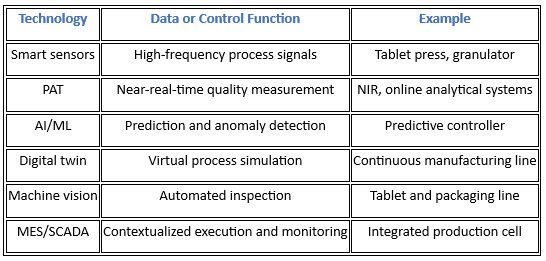
The next generation of pharmaceutical manufacturing equipment is becoming a cyber-physical production asset. Sensors collect high-frequency signals; control systems respond to process conditions; PAT provides analytical information; AI models identify patterns; digital twins support simulation; robotics and vision automate physical tasks; and MES connects machine events with manufacturing context.
The projected expansion of the pharmaceutical manufacturing equipment sector to $18.45 billion by 2034 indicates the commercial scale of this transition. The FDA's continuous-manufacturing guidance and Emerging Technology Program data, together with its research involving AI, advanced process control, and digital twins, demonstrate the regulatory and technical attention being given to advanced manufacturing.
The measurable shift is from isolated equipment toward integrated production systems where performance can be monitored, analyzed, and controlled continuously.
For pharmaceutical manufacturers, the next equipment decision is therefore increasingly defined by a broader set of measurable requirements: how effectively can the machine measure, communicate, predict, and respond while remaining within validated manufacturing controls?
Reference:
About The Author:
Raksha Sharma is a professional writer and researcher at DataIntelo, specializing in emerging technologies, business developments, and data-driven research. She focuses on producing clear, research-based content that helps readers understand complex technical and business topics in a practical and accessible way.