
Bayer Adds A Spine To Modularity For Scale Without Disruption

By Katie Anderson, Chief Editor, Pharmaceutical Online
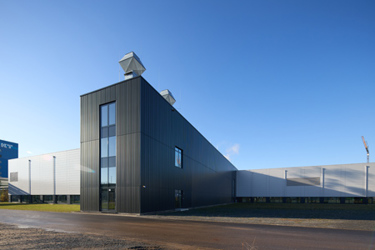
As pharmaceutical manufacturers face increasing pressure to accelerate product launches, manage more variable pipelines, and respond to shifting market demand, facility design has become a critical part of long-term manufacturing strategy. Fixed-capacity plants can make it difficult to scale efficiently or integrate new technologies without major disruption.
Modular facility concepts offer a different path, giving manufacturers the ability to expand capacity stepwise, standardize core infrastructure, and adapt production environments as product portfolios evolve. Trailblazing in modular facility design is Bayer’s Solida 1, which just won TWO 2026 ISPE Facility of the Year Awards for Pharma 4.0 and Operational Excellence. Of course, I had to learn more, so I sat down with Bayer’s Juergen Wiedemann, Sharmaine Mannan and Christoph Ebbecke to discuss how its SOLIDA-1 facility applies a central spine-plus-modules architecture to support scalable capacity, multipotency oral solid dose manufacturing, advanced automation, and future expansion while maintaining quality, efficiency, and operational resilience.
What was the primary strategic driver behind choosing a modular facility design for SOLIDA‑1?
Bayer Team (BT): The primary driver was to create a manufacturing platform that combines speed, flexibility, and long-term resilience. SOLIDA-1 was designed to help bring innovative medicines to patients faster while maintaining high quality and competitive cost. Its modular design allows Bayer to expand capacity stepwise, integrate new technologies with minimal disruption, and adapt the site as the portfolio evolves. In that sense, the design was driven not only by engineering considerations, but by a clear strategic objective: build a future-ready manufacturing platform.
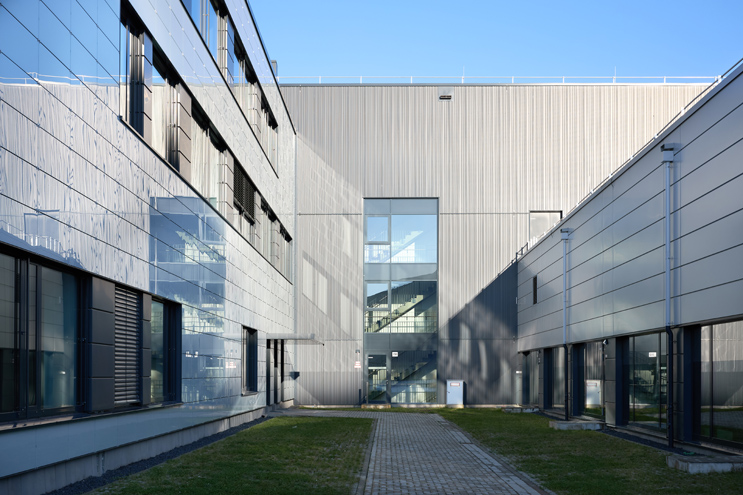
How does the central “spine plus modules” architecture improve scalability and flexibility compared to a traditional pharmaceutical facility?
BT: The “spine plus modules” architecture separates shared infrastructure from production areas, making expansion easier than in a conventional plant. The spine serves as the operational backbone for personnel flow, material flow, utilities, and waste management, while each module functions as a self-contained unit. Bayer can extend the spine and add production modules without redesigning the entire site. This reduces interface complexity, limits disruption during adaptations, and creates a repeatable structure that can scale with future requirements. Changes within one module also can be made without affecting the rest of the facility.
How does the modular concept help Bayer respond to pipeline variability and changing product demand?
BT: Modularity allows Bayer to align manufacturing capacity more closely with portfolio changes and market uptake. Rather than building all future capacity upfront, the company can add modules as demand grows. SOLIDA-1 also was designed for very different product profiles, from high-volume, low-potency cardiovascular products to low-volume, high-potency oncology compounds. Scalable infrastructure, interchangeable equipment, and adaptable production spaces help Bayer respond to pipeline variability without major redesign, stranded investment, or prolonged disruption.
What design features allow the facility to support both low‑potency and high‑potency oral solid dose products?
BT: SOLIDA-1 supports both low-potency and high-potency oral solid dose products through modular process design, engineered containment, and controlled operations. Its Automated Modular Formulation (AMF) system uses standardized unit operations and scalable batch sizes, allowing different products and potency levels to run on shared equipment and infrastructure. Layered containment provides primary protection at the equipment level through closed processing and secondary protection at the room level. The HVAC system can operate in overpressure mode for low-potency products and under-pressure mode for high-potency products. Automated CIP/WIP cleaning, verification-based changeovers, and a strict one-product-at-a-time operating model help control cross-contamination risk and support safe, flexible multipotency manufacturing.
How quickly can a new production module be added, qualified, and integrated into operations?
BT: Using SOLIDA-1’s standardized layout, utilities, and automation concept, a new production module can be brought to commercial readiness in about two years, including qualification. That is typically more than a year faster than expansion in a traditional pharmaceutical facility. Modules can be constructed alongside ongoing operations, while shared logistics and utilities are pre-dimensioned for expansion. The copy-paste approach reuses proven designs, validation concepts, and digital templates, reducing engineering effort, qualification risk, and start-up complexity.
What engineering and automation standards were established to ensure future modules can be added seamlessly?
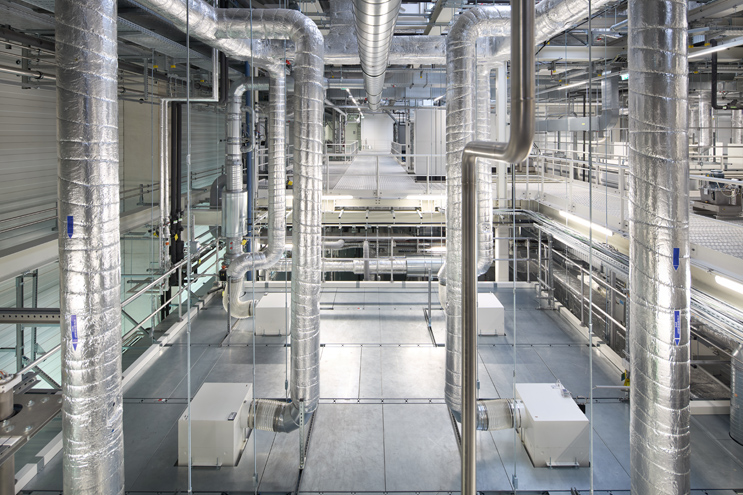
BT: SOLIDA-1 uses engineering and automation standards designed for seamless future expansion. On the engineering side, these include standardized module templates, repeatable layouts, a 1.2-meter modular grid, and a defined utility concept that assigns each medium to a specific height level with a single vertical drop at the point of use. On the automation side, standardized interfaces and communication technologies allow entire process units to be exchanged as production requirements change. Together, these standards simplify integration, reduce project risk, and support copy-paste scalability.
How does the MES/DCS and orchestration architecture support modular expansion and plug‑and‑play functionality?
BT: SOLIDA-1’s digital architecture was designed for modular expansion. The MES provides batch context and target parameters, while validated recipes reside on the process units to reduce interface complexity. The custom-developed Production Flow Control system orchestrates material flow, robotics, and AGVs independently of individual modules. This allows new modules or process units to connect into the existing operating framework without re-engineering the control model. Standardized interfaces enable plug-and-play integration within the automated production ecosystem.
What were the biggest technical or operational challenges encountered while implementing the modular design concept?
BT: The biggest challenge was implementing multi-level modularity across the building, process, and equipment layers without sacrificing efficiency or flexibility. Bayer had to standardize layouts, cleanroom concepts, utilities, containment, and personnel and material flows while still accommodating different products, technologies, and expansion scenarios. At the process and equipment level, unit operations, containment needs, vendor interfaces, and automation philosophies were not naturally uniform. Achieving true plug-and-play modularity required deliberate standardization and orchestration, including a custom Production Flow Control layer and robotics and container concepts adapted for pharmaceutical use.
How does the modular strategy support Bayer’s long‑term vision for autonomous or “lights‑out” manufacturing?
BT: Modularity is a structural precondition for autonomous manufacturing. Standardized modules, centralized flow through the spine, and an automation-friendly layout make it possible to connect process units, robotics, AGVs, and digital control systems in one integrated operating environment. MES-driven execution, digital batch records, automated cleaning, and the Production Flow Control system further reduce manual intervention across production and logistics. Together, these elements provide the foundation for a future lights-out manufacturing concept.
Based on lessons learned from SOLIDA‑1, how do you see modular pharmaceutical facilities evolving over the next decade?
BT: Over the next decade, modular pharmaceutical facilities will likely become more standardized, digitally integrated, and rapidly deployable. SOLIDA-1 shows that modularity delivers the most value when paired with automation, standardized interfaces, and a strong digital backbone. Future facilities will build on repeatable module templates, faster capacity expansion, easier technology integration, and stronger data-driven operations. Rather than being designed around fixed products, they will be built for continuous reinvention across therapies, technologies, and manufacturing networks.