
Beyond API Sourcing: Avoiding Supply Disruptions For Small Molecule Drugs
By Shammi Thakur, research director, Vyansa Intelligence
A small molecule drug can have more than one approved active pharmaceutical ingredient (API) supplier and still face a serious supply risk. The exposure may sit in a critical intermediate, a specialized excipient, an analytical capability, a manufacturing site, or a packaging component that has few practical substitutes.
The 2023 cisplatin shortage illustrated how quickly a manufacturing disruption can become a broader supply problem. The FDA reported that it worked with manufacturers to expand production, helped a former manufacturer reenter the market, and temporarily exercised importation flexibility before determining in June 2024 that national cisplatin supply exceeded demand.¹ The response was not simply a matter of finding another supplier; it involved manufacturing capacity, regulatory review, and coordination across the supply chain.
For small molecule manufacturers, that distinction matters. Supply resilience should be assessed across the complete drug product pathway rather than measured by the number of vendors listed in a procurement system.
Map The Entire Product Path
The first step is to follow the drug product backward from the finished dose to the materials and capabilities required to make it. A useful map looks like this:
- Starting materials
- Intermediates
- API
- Formulation
- Manufacturing
- Testing
- Packaging
- Release
Each stage can contain a different type of dependency.
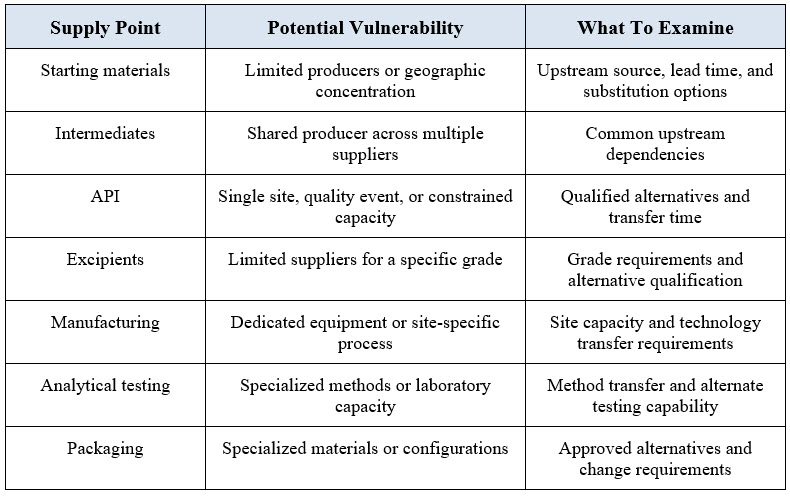
This exercise often reveals risks that a standard supplier review misses.
Two API suppliers may purchase the same critical intermediate. Two manufacturing sites may depend on the same analytical laboratory. Several suppliers may move materials through the same logistics corridor. The apparent number of options can therefore overstate the number of genuinely independent paths to production.
Qualification Time Is A Supply Variable
The existence of an alternate supplier does not make that supplier an immediately usable source.
A manufacturer may need to complete some combination of supplier qualification, technical assessment, analytical comparison, process validation, technology transfer, stability work, and regulatory activities before material from a new source can support commercial production. That creates an important planning question: How long does it take to convert an alternate supplier into qualified supply?
The answer should be compared with the amount of inventory available for the product. For example:
- 60 days of inventory + 120-day qualification timeline = an unresolved short-term exposure.
- 180 days of inventory + 120-day qualification timeline = a materially different contingency position.
The exact numbers will vary by product and regulatory pathway, but the principle is consistent. Qualification time should be treated as part of supply risk, not as an administrative step that sits outside the risk calculation. Manufacturers should therefore record not only whether an alternate source exists, but also whether it can be activated within the product's available supply window.
Look Below The API
The API receives most of the attention in supply chain discussions, but vulnerabilities can sit further upstream. Starting materials and intermediates can be constrained by limited production capacity, changes in raw material economics, environmental requirements, or temporary plant shutdowns. A manufacturer may not see the exposure until the disruption reaches its direct supplier.
Chemical inputs can create the same problem. Vyansa Intelligence’s research on the acetonitrile market estimates that pharmaceutical applications account for around 50% of demand. Acetonitrile is used in API synthesis as well as analytical applications such as high-performance liquid chromatography (HPLC), meaning an upstream supply disruption can affect both manufacturing and testing. Vyansa’s analysis also notes that acetonitrile production is closely linked to acrylonitrile production, making supply sensitive to factors such as plant shutdowns, raw material availability, and operating conditions.⁴
The same principle applies to excipients. A formulation change may appear straightforward from a procurement perspective, but an excipient can affect product performance, analytical behavior, stability, or impurity risk. Switching sources therefore requires more than confirming that the new material meets a purchasing specification.
Treat Quality Changes As Supply Changes
Supply continuity cannot be separated from quality oversight.
FDA's September 2024 guidance on nitrosamine impurities recommends that manufacturers of APIs and drug products assess potential sources of nitrosamine formation, conduct testing where appropriate, and implement controls to prevent or reduce unacceptable levels.² The FDA also notes that nitrosamine drug substance-related impurities can be associated with the API's chemical structure and may arise from manufacturing or storage conditions.
The implication for supply planning is practical. A change in source, process, material, or formulation can create a new quality question even when the objective is simply to protect supply.
Before qualifying an alternate route, manufacturers should ask:
- Does the material have the same relevant impurity profile?
- Will the analytical method remain suitable?
- Could the process introduce a different impurity risk?
- Would formulation changes affect stability or bioequivalence?
- What regulatory work is required before implementation?
The FDA's nitrosamine work provides a useful reminder that an apparently minor change in the supply chain can have consequences for the finished drug product. The supplier decision and the quality decision therefore need to be considered together.
Build Flexibility Before A Shortage
The strongest contingency plans are usually established before a disruption forces a manufacturer to act. That does not mean qualifying every possible supplier. It means identifying which dependencies justify the investment in additional options.
A practical prioritization approach is:
- Identify the consequence: Determine which material, capability, or site failure could stop production or delay product release.
- Trace the dependency upstream: Continue beyond the direct supplier to identify shared intermediates, raw materials, specialized services, and logistics routes.
- Measure qualification time: Document the actual time required for audits, testing, technology transfer, validation, stability work, and regulatory activities.
- Test usable capacity: Ask how much production the alternate source can realistically absorb if several customers require additional volume simultaneously.
- Compare the recovery window with inventory: The contingency should be evaluated against the number of days or weeks available before finished product supply becomes constrained.
- Assign a mitigation that matches the failure: Not every vulnerability requires another supplier. Some require additional inventory, earlier technical qualification, alternate logistics routes, expanded manufacturing capacity, or closer monitoring of an upstream input.
This approach shifts the discussion from “How many suppliers do we have?” to “How many qualified paths can actually keep the product moving?”
Measure Independence, Not Just Redundancy
Supplier count is easy to report. Independence is harder to measure, but it is more informative.
Manufacturers should consider tracking several indicators together:
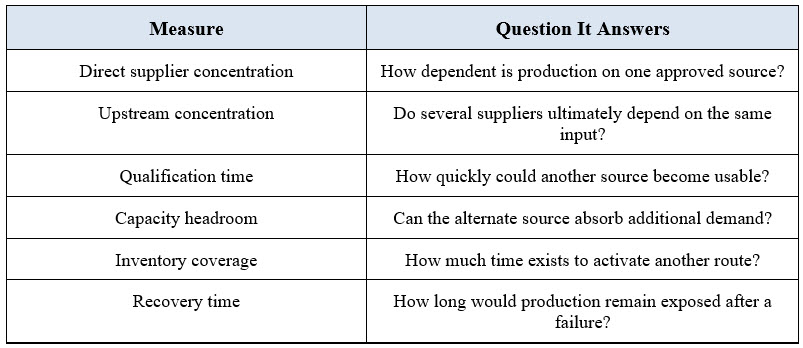
These measures also help distinguish between different types of supply risk.
A single-source API with six months of inventory presents a different problem from a dual-sourced API with only six weeks of inventory and a long qualification process. Likewise, two suppliers located in different countries may still represent one effective dependency if both rely on the same upstream producer.
Use Early Signals, Not Just Shortage Data
Supply planning also benefits from monitoring events before they become shortages. FDA's CY 2025 Drug Shortages Report to Congress states that the agency and manufacturers successfully prevented 330 potential drug shortages during the year using tools that included regulatory flexibility and other mitigation measures. The same report recorded four new drug shortages during 2025.⁴
For manufacturers, the lesson is less about the headline numbers than about timing. A plant shutdown, quality investigation, supplier financial problem, extended maintenance event, or unexpected reduction in available capacity can provide an opportunity to activate contingency plans before finished product inventories become critical. Internal monitoring can therefore combine:
- supplier quality signals
- changes in promised lead times
- production interruptions
- raw-material availability
- capacity utilization
- regulatory or inspection events
- inventory coverage
- open qualification activities.
The earlier a manufacturer identifies a deteriorating supply condition, the more options remain available.
Start With The Product, Not The Supplier List
Supplier diversification remains an important part of small molecule manufacturing strategy, but it is not the same as resilience. A manufacturer can have multiple approved vendors and still depend on one upstream material, one specialist capability, one testing route, or one qualification pathway. Conversely, a smaller supplier base can be manageable when the remaining sources are genuinely independent, qualified, appropriately stocked, and capable of absorbing demand.
For small molecule drug products, the better starting point is therefore the product itself.
Map the route from starting materials to release. Identify where supply can converge. Measure how long alternatives take to qualify. Assess whether those alternatives have usable capacity. Then match each critical dependency with a mitigation that can be activated before the available supply window closes. That turns supply resilience from a supplier-count exercise into a manufacturing decision.
References:
- U.S. Food and Drug Administration (FDA). FDA Roundup: June 28, 2024. June 28, 2024
https://www.fda.gov/news-events/press-announcements/fda-roundup-june-28-2024 - U.S. Food and Drug Administration (FDA). Control of Nitrosamine Impurities in Human Drugs: Guidance for Industry. September 2024
https://www.fda.gov/regulatory-information/search-fda-guidance-documents/control-nitrosamine-impurities-human-drugs - U.S. Food and Drug Administration (FDA). CY 2025 Drug Shortages Report to Congress. 2026
https://www.fda.gov/media/193637/download - Vyansa Intelligence. Global Acetonitrile Market Report: Trends, Growth and Forecast (2026–2032). 2026.
https://www.vyansaintelligence.com/industry-report/acetonitrile-market-trend
About The Author:
 Shammi Thakur is research director at Vyansa Intelligence, with more than 15 years of experience in strategic market intelligence, industry forecasting, and competitive analysis. He leads research across pharmaceutical and healthcare sectors, with a focus on manufacturing, supply chains, industry trends, and evidence-based analysis.