
Chugai Accelerates Automation To Boost Operational Efficiency

By Katie Anderson, Chief Editor, Pharmaceutical Online
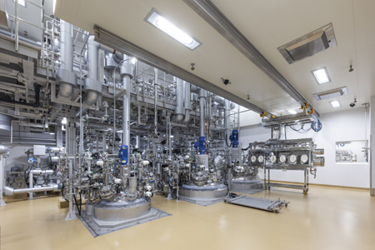
What do you do when tasked with producing drugs of different molecular sizes, including highly potent compounds, in the same facility on a global scale? You tap technological advances in automation, modular design for flexibility, and tie it together with systems that enable real-time data. That’s exactly what Chugai Pharmaceutical Co., Ltd. did when designing its FJ3 facility to produce macrocyclic peptides and small molecule API for the world, which recently won an honorable mention at the 2026 ISPE Facility of the Year Awards. I sat down with multiple Chugai FJ3 project contributors, who walked me through how the company used advanced automation to reduce human error, enhance process reliability, and improve overall operational efficiency.
What issues did full automation solve in the facility?
Chugai Expert (CE): Full automation streamlined manufacturing operations and routine inspections, significantly improving operational efficiency and consistency. It addressed challenges related to workforce availability while enabling more effective allocation of human resources to higher-value activities. In addition, by minimizing manual valve operations and human interventions, full automation reduced the risk of human error and enhanced process reliability, ultimately contributing to improved product quality and compliance.
Please describe your approach to fully automate production?
CE: Our approach to full automation was based on developing a highly flexible and modular manufacturing concept applicable to both small molecules and mid-sized molecules. From the design phase, we structured the manufacturing process into standardized functional blocks, each representing a specific unit operation such as charging, reaction, sampling, or cleaning. For each block, dedicated automated sequences were developed to ensure consistent and reliable execution. By combining these sequences, we established flexible manufacturing recipes tailored to different products and processes. This modular approach enabled us to achieve a high level of automation while maintaining adaptability across various modalities. In addition, the implementation of a closed and integrated system minimized human intervention and manual operations, improving process consistency, data integrity, and overall operational robustness.
What level of automation was targeted for material handling, production, and quality operations?
CE: Our target was to achieve a high level of automation across material handling, production, and quality operations by integrating advanced digital technologies throughout the entire manufacturing workflow.
For material handling, we implemented a fully automated warehouse management system with automated storage, retrieval, and material transfer to ensure accuracy, traceability, and efficiency.
In production, all unit operations were automated through standardized control sequences, enabling consistent execution of manufacturing processes with minimal human intervention. These sequences are centrally managed and integrated into flexible manufacturing recipes.
For quality operations, we established automated monitoring and control functions, including real-time data acquisition and alarm management, allowing early detection of abnormalities and rapid response. By integrating these elements into a unified system, we enhanced operational consistency, data integrity, and overall process reliability.
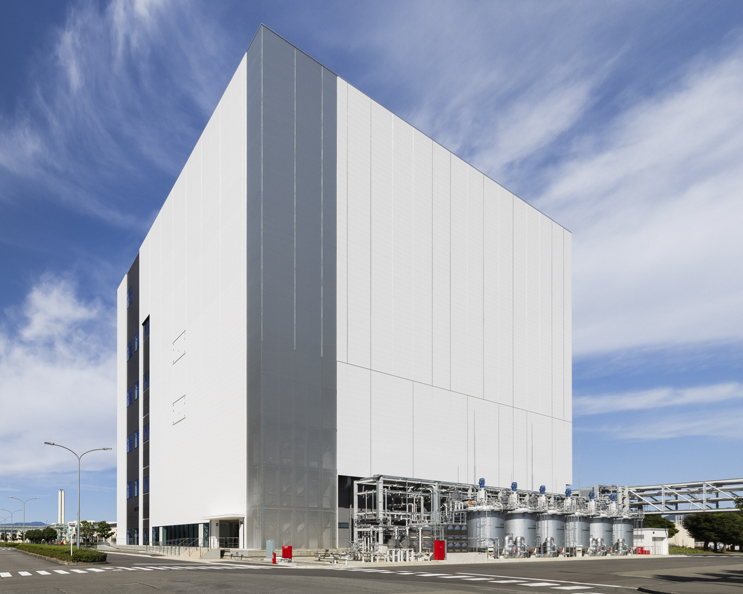
Chugai's FJ3 Production Building
Which operations still require manual intervention, and why?
CE: Certain operations such as weighing and powder charging into reaction vessels still require manual intervention. This is primarily due to the need to operate in explosion-proof environments, where the application of robotic systems requires highly specialized designs and rigorous qualification.
In addition, the facility is designed to handle highly potent compounds, which require stringent cleaning procedures after equipment use. For equipment used in weighing and charging operations, achieving reliable and validated cleaning performance is critical, and automating these processes presents significant technical challenges in ensuring effective decontamination and safe operation. Therefore, we have adopted a risk-based approach, maintaining manual operations for these steps while implementing strict procedural controls to ensure safety, containment, and consistency.
What is an integrated distributed control system, and how does it work in your facility?
CE: An integrated distributed control system (DCS) is a system in which process control and monitoring of manufacturing equipment are performed by distributed controllers while being centrally managed for overall coordination and supervision.
In FJ3, DeltaV is primarily used as the DCS to precisely control key process parameters such as temperature and pressure, serving as the core platform for automated equipment and process control across the facility. Operational data collected by the DCS is integrated into the MES and centrally managed as part of manufacturing execution records. This enables seamless alignment between manufacturing instructions, execution, and data recording, ensuring strong data consistency and full traceability throughout the production process. As a global-scale API manufacturing facility, the system is also designed with a strong focus on safety and reliability. Redundancy is built into the DCS architecture, along with alarm management and automated safety shutdown functions in the event of process abnormalities. These features ensure high system availability, operational safety, and robust process reliability.
What important lessons did you learn through the design of the facility?
CE: FJ3 was designed with a strong focus on advanced automation. One of the most important lessons learned was the critical importance of involving cross-functional stakeholders from the early stages and addressing process design, automation design, risk assessment, and safety design in parallel rather than sequentially. In previous projects, these elements were often considered in separate phases, which led to rework and additional adjustments in later stages. In FJ3, system engineers, manufacturing operators, and process engineers worked together from the beginning to define processes, identify automation requirements, and assess risks. This integrated approach enabled potential issues to be identified and resolved during the design phase. As a result, we were able to align with a tight project schedule while maintaining the quality of design deliverables and minimizing rework. This experience demonstrated that early stage integrated design is essential for achieving both efficiency and quality in complex manufacturing facilities. It also reinforced the importance of collaboration and shared understanding across functions in building a robust and reliable production environment.
How do you troubleshoot any issues in the facility?
CE: During the design phase, we identify potential troubleshooting scenarios and assess their impact on safety, quality, and the environment. Risks are quantified based on the combination of occurrence frequency and severity, allowing us to determine overall risk levels. For risks exceeding predefined thresholds, mitigation measures are implemented and verified before being incorporated into the facility design. During operation phase, issues are detected through real-time monitoring and alarm management systems, enabling early identification of abnormalities. Standardized procedures are then followed to ensure a prompt and consistent response. Furthermore, all incidents are subject to root cause analysis, and the lessons learned are systematically fed back into both design and operational practices. This continuous improvement approach ensures sustained reliability, safety, and product quality throughout the facility lifecycle.
A Look Ahead to Digitization
Though Chugai’s automation and modular design allowed it to produce different types of molecules efficiently and flexibly, it still needed to put systems in place to allow its components to communicate, generate real-time data, and keep the manufacturing running at world-class speeds. In part II of this piece, I talk to Chugai’s FJ3 experts on the facility’s digital journey and web of integrated systems.