
Considerations When Selecting Cleanroom Monitoring Systems

A cleanroom monitoring system (CMS) is a set of devices, with one or several particle counters, which samples the air at different points in the clean room, counts the particles there either continuously or sequentially, compares the counts obtained with pre-set values and, in event of their exceeding the latter, sets off alarms. The CMS is controlled by a PC which stores all the measurements made to allow for history studies.
The particle monitoring system can be completed with temperature probes, relative humidity, air speed, differential pressure, etc., to give information on the maintenance of ambient conditions necessary for the clean room.
Sources of Contamination
Provided the necessary technology is used in its construction, with air filtering through HEPA filters, a cleanroom will provide an appropriate atmosphere for the manufacture of electronic and pharmaceutical products. However, personnel entering the room constitute the main source of contamination. For example, a human being emits about 10 million skin cells per day, and maintains approximately 2,300 organisms on each square centimetre of skin.
According to most regulations regulations, personnel must be completely covered with clothing that does not shed fibres, goggles, gloves and the like. In spite of this, contamination arises from faulty handling, inappropriate techniques, or a low quality room, all of which is reflected in an increase of rejects in production. A monitoring system gives rapid information on contamination levels.
Keeping the Process Under Control
Whenever there is an unacceptable change in the quality of a product processed aseptically, the manufacturer must learn which events are influencing the process. The question to be answered is:
What has changed to make this process abnormal? For example:
- Change in personnel?
- Change in the process?
- Change in ambient conditions?
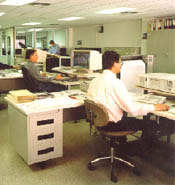
Fortunately a good CMS makes obtains most, if not all the data needed to solve the problem. A CMS gives continuous measurement of the particles, temperature, relative humidity, air speed in the HEPA filters and differential pressure. Batch information will permit correlation of data, both history and present, by supplying the various ambient parameters and showing them simultaneously in graphic form.
Prevention and Cure
The CMS continuous monitoring mode makes it possible to study data over very long periods, showing the condition of HEPA filters and air supplied by means of air speed and differential pressure probes. Based on this data, predictions can be made of when to replace the absolute filters or carry out air system maintenance. This provides for more effective programming of the task of the maintenance team.
Daily details by shift, day or week provide a rapid knowledge of the ambient conditions which may have got out of control. Frequent changes in air speed or differential pressure may indicate unacceptable movement on entering and leaving the sterile area.
An Ideal CMS
A modern CMS for an advanced manufacturing process must fulfil the following requirements:
- Data acquisition from multiple sources: air particle count, temperature, relative humidity, air pressure and differential pressure in the most crucial parts of the clean room and controlled areas.
- Measurement storage, with an eye on preset values
- On screen display of the actual situation in the areas monitored.
- Alarms – both audio and visual – if the preset levels are exceeded. Storage of all the data in an alarms file which can be printed out immediately or later on.
- Rapid flexible access from various locations.
- Report generation.
- Database management for future reference or long term tendency analysis. This feature must include statistical tools for process control and analysis.
- Software and hardware which is adapted and flexible to future applications.
Monitoring and Particle Counters
Pharmaceutical industry regulations for particle count may be met by using a particle counter on a trolley as well as a CMS. In a site with various filling areas, the advantages of an CMS soon pay off the acquisition cost in the following ways:
- The CMS avoids the entry of personnel to carry out counting.
- The CMS is always on alert, tracing problems and reporting them at once. Production affected by a problem can be easily isolated.
- There are no data transcription errors with CMS.
- CMS provides facilities for making reports and analyzing tendencies.
- CMS data may be consulted long after it has been obtained.
- Low maintenance costs
Computer System Validation
For GMP (Good Manufacturing Practice) the Monitoring System must be validated. In this section, special mention must be made of computer application validation as regulated by GAMP (Good Automated Manufacturing Practice) norms. Qualification of software for GAMP norms, involves a thorough knowledge of computer programmes and automatics used.
Validation is carried out in several stages:
Definition and Description of the System. This process covers a description of all hardware and software used by the computer system as well as their purpose and aims with reference to all descriptive documents, particularly those relating to the user's requirements and functional specifications
Qualification of the System. IQ, OQ PQ. IQ and OQ qualification procedures are developed for hardware and software and serve to verify that the system works according to the client's requirements and specifications. The basic steps are as follows:
(IQ) installation qualification. IQ procedures are drawn up with regard to the installation process of the system and all the hardware, software, adaptation of site premises, operating conditions, certificates and tests performed during such installation by the supplier.
(OQ) operating qualification. Drawing up procedures for static and dynamic tests of basic working aspects after the system has been installed. This section covers development of tests for all system functions.
(PQ) process qualification. Checking the functions intended for the system according to the requirements, functional specifications and operating processes in view at the different levels of use and function. The performance of the system will be verified in its actual working processes.
At this stage, a check will be made of the existence and suitability of the normalized work procedures necessary from the GMP point of view to work with he system.
Summary Validation Report
When the various stages of the computer system validation plan have been completed, the validation report will be made available to anyone who requires it. Included in the report are all documents produced during the process as well as recommendations for corrective action.
For more information: Robert Bullich, Chemical Engineer, Telstar S.A., Josep Tapiolas 120, E-08226 Terrassa, Spain. Tel: +34 31-785-2800. Fax: +34 31-785-9342.