
FDA Rethinks Skin Sensitization Testing For Generic Transdermal And Topical Delivery Systems
By Tim Sandle, Ph.D.
For developers of generic transdermal and topical delivery systems (TDS), a patch or other delivery system must interact appropriately with the skin. Irritation, sensitization, and adhesion are interconnected with product performance, patient acceptability and, potentially, drug delivery. The U.S. Food and Drug Administration (FDA) has refined its expectations for such considerations in a July 2026 revised draft guidance, Assessing the Irritation and Sensitization Potential of Transdermal and Topical Delivery Systems for ANDAs. The document, Revision 2, is set to replace the version issued in April 2023, following public consultation.
The guidance applies to studies supporting abbreviated new drug applications (ANDAs). The FDA indicates that the revision is intended specifically to clarify the design and conduct of in vivo irritation studies and combined irritation/sensitization studies, including when sensitization testing may not be needed.1,2 The 2023 draft largely presented irritation and sensitization through a combined-study paradigm, recommending comparison of test (T) and reference (R) TDS products in at least 200 evaluable subjects under provocative conditions. It acknowledged circumstances where sensitization assessment could be unnecessary but this relied more heavily on case-specific justification.3 The 2026 revision provides a much clearer distinction between an irritation-only pathway and the larger combined irritation and sensitization pathway. For generic-drug developers, this potentially changes both development strategy and clinical-study burden.
Characterizing Irritation And Sensitization
A TDS creates an unusual interface between formulation, device, and human skin. Product composition, the active ingredient, occlusivity, environmental humidity, and the condition of the skin can influence irritation or sensitization. In the draft guidance, the FDA emphasizes that environmental temperature and water exposure may alter the release and permeation of formulation components and the hydration of skin beneath the system.1 There is also a mechanical dimension in that removal of an adhesive system can itself injure the skin. The FDA specifically identifies stripping of the stratum corneum during TDS removal as a mechanism capable of producing irritation. Consequently, adhesive properties cannot be considered independently from dermal tolerability.1
Dermal tolerance belongs with TDS performance. The FDA's separate July 2026 final guidance on adhesion explains that adhesion studies may be conducted independently or combined with other objectives, including pharmacokinetic bioequivalence evaluation.4 The result points toward an increasingly integrated regulatory picture: Formulation composition, adhesion, clinical skin response, and drug delivery must be considered as related characteristics rather than isolated development exercises.
Separating Irritation From Sensitization
The most consequential feature of Revision 2 is the FDA's clearer separation of clinical irritation testing from sensitization testing. Under the April 2023 approach, the FDA recommended at least 200 evaluable subjects for comparative irritation/sensitization assessment, conducted under provocative conditions involving repeated removal and reapplication at the same skin site. The agency recommended that irritation and sensitization be evaluated within a single study where sufficient subjects were included to assess sensitization.3 In contrast, Revision 2 establishes a specific irritation-only route.
This means that when only irritation potential is being evaluated, the FDA recommends a minimum of 40 evaluable subjects, or sufficient subjects to provide statistical power of at least 0.80, whichever is greater. The study consists of a 21-day induction phase under provocative conditions.1 Where sensitization evaluation is appropriate, however, the more extensive design remains. The FDA recommends at least 200 evaluable subjects, a 21-day induction period, a 14- to 17-day rest period, and a subsequent challenge phase.1
This difference could be highly significant for industry. Table 1 provides a comparison between the Revision 1 (draft issued in 2023) and the draft 2026 Revision 2 document.
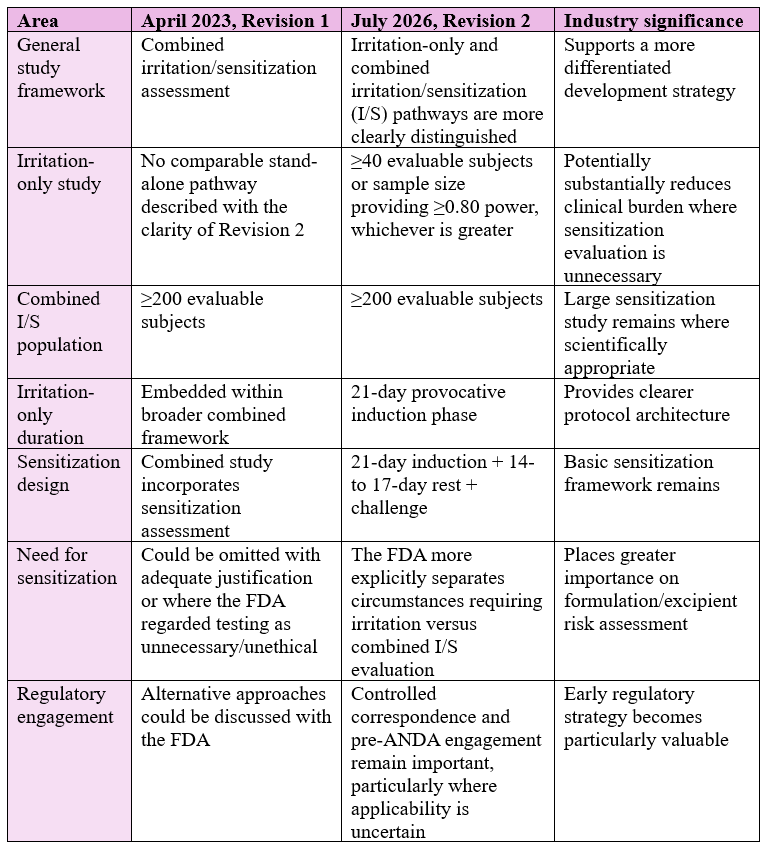
Table 1: Comparison of Revision 1 (2023 draft) and Revision 2 (2026 draft)
From Table 1, the underlying distinction is that irritation and sensitization are not interchangeable toxicological phenomena. Irritation represents a nonimmune local inflammatory response, whereas sensitization involves acquisition of an immune-mediated allergic response following prior exposure. The 2026 structure better recognizes that assessing every generic TDS for both outcomes may not necessarily provide proportionate additional information.
A Risk-Based Decision Is Replacing A Default Testing Approach
Revision 2 states that the FDA generally recommends an in vivo study evaluating irritation potential unless a difference in an inactive ingredient compared with the reference product warrants evaluation of both irritation and sensitization.1 The guidance also notes circumstances in which sensitization assessment is unnecessary or unethical, including where the active ingredient is a known skin sensitizer or the components and composition of the TDS are the same as those of the reference listed drug (RLD).1 This changes the central approach to development planning.
For sponsors, the early question shifts from "How do we conduct an I/S study?" to "What scientific evidence demonstrates which study is appropriate?" In turn, this puts greater emphasis on the development-stage understanding of:
- qualitative and quantitative formulation differences
- inactive ingredient history and sensitization potential
- adhesive composition
- RLD composition and labeling
- product-specific guidance
- duration and conditions of wear
- prior regulatory knowledge concerning components of the system.
Where uncertainty remains, the draft explicitly points applicants toward FDA feedback through controlled correspondence or pre-ANDA meetings.1 For generic developers, therefore, formulation decisions that appear minor from a conventional CMC (chemistry, manufacturing, and controls) perspective may have downstream clinical-development consequences if they change the dermal-risk profile.

Study Design Is Set To Become More Explicit
The FDA retains the use of deliberately provocative exposure. During the 21-day induction phase, T and R systems are applied at contralateral locations of the same anatomical site and repeatedly removed and replaced for durations representative of the RLD's labeled wear period.1 For sensitization assessment, a 14- to 17-day rest interval follows induction, which guards against reactions like dermatitis6. During challenge, the TDS is applied to a previously untreated, or naïve, skin site for 48 hours. Skin reactions are then assessed at 30 minutes and at 24, 48, and 72 hours after removal. Subjects exhibiting a potential sensitization reaction should undergo rechallenge four to eight weeks later.1 The draft also retains detailed controls over study conduct. Randomization of test and reference products to application sites should be documented; trained observers should evaluate adhesion and skin reactions; and consistency between scorers should be demonstrated where the same assessor cannot conduct all observations.1
The FDA recommends allowing normal bathing or showering for products with wear periods up to a period of 24 hours, consistent with RLD labeling. Subjects should not have their movement restricted. These provisions attempt to preserve a provocative assessment while keeping exposure relevant to intended use.1
Irritation Testing Cannot Be Separated From Adhesion
The Revision 2 draft coincides with a shift in FDA thinking on TDS adhesion. In July 2026, the FDA also finalized Assessing Adhesion With Transdermal and Topical Delivery Systems for ANDAs, replacing the April 2023 Revision 2 draft.4 The FDA's irritation guidance requires adhesion to be assessed before TDS removal because adequate skin contact is needed to produce a suitably provocative exposure. Where tape or an overlay is permitted to reinforce a lifting system, irritation attributable to the reinforcement material should be reported separately from irritation associated with the TDS application area.1 Together, the guidances reinforce a core development principle: Adhesion, dermal safety, and drug delivery are interacting components of TDS performance. Hence, a poorly adhering generic patch may not provide an informative irritation comparison, because insufficient contact can reduce exposure.Conversely, excessively aggressive adhesive can contribute to mechanical skin trauma on removal.
What Should Industry Do Differently?
The revised framework has several practical consequences. First, generic TDS developers should make the irritation-versus-sensitization decision early rather than treating the clinical I/S program as a standard late-development package. Excipients and adhesive choices should be evaluated partly against the evidence needed to justify the applicable clinical pathway.
Second, sponsors with products that can scientifically support irritation-only assessment may have an opportunity to avoid a larger sensitization component7. This is likely to affect recruitment requirements, study complexity, and overall development burden. The FDA itself says the revised guidance is intended to reduce duplicative efforts, regulatory delays, and process uncertainty for industry.5
Third, sponsors should avoid interpreting the 40-subject figure as an automatic sample size. The FDA says 40 evaluable subjects or the number needed to achieve at least 80% statistical power, whichever is larger.1 Therefore, study-specific statistical assumptions remain important. Fourth, developers should evaluate the guidance alongside applicable product-specific guidance rather than using it as a stand-alone template. The FDA expressly recommends this combined approach.1
Finally, sponsors should remember the regulatory status of the document. Revision 2 is still draft guidance and contains nonbinding recommendations. The FDA states that alternative approaches can be used when they satisfy applicable statutory and regulatory requirements.1
A Proportionate Approach To Dermal Safety
The significance of the 2026 revision lies less in changing the fundamental science of skin assessment than in making the regulatory pathway more proportionate to risk. Under the previous framework, the combined irritation/sensitization study occupied center stage. Revision 2 makes the distinction between irritation assessment and sensitization assessment much more operational. For qualifying products, a focused study involving at least 40 evaluable subjects represents a very different proposition from a combined study requiring at least 200. This should not be interpreted simply as regulatory relaxation, as the focus shifts toward better scientific justification: understanding formulation differences, excipient risks, adhesive behavior, labeled conditions of use, and the relationship between skin contact and product performance. Consequently, development strategies should no longer approach adhesion, irritation, sensitization, and bioequivalence as disconnected factors. These factors instead form a linked body of evidence describing how a delivery system behaves at its most important interface: the patient's skin.
References
- U.S. Food and Drug Administration. Assessing the Irritation and Sensitization Potential of Transdermal and Topical Delivery Systems for ANDAs: Draft Guidance for Industry. Revision 2. Silver Spring (MD): FDA, Center for Drug Evaluation and Research; 2026: https://www.fda.gov/media/167073/download
- U.S. Food and Drug Administration. Assessing the Irritation and Sensitization Potential of Transdermal and Topical Delivery Systems for ANDAs; Revised Draft Guidance for Industry; Availability. Fed Regist. 2026;91:48882: https://www.federalregister.gov/documents/2026/08/03/2026-15612/assessing-the-irritation-and-sensitization-potential-of-transdermal-and-topical-delivery-systems-for . Federal Register notice
- U.S. Food and Drug Administration. Assessing the Irritation and Sensitization Potential of Transdermal and Topical Delivery Systems for ANDAs: Draft Guidance for Industry. Revision 1. Silver Spring (MD): FDA, Center for Drug Evaluation and Research; 2023: https://downloads.regulations.gov/FDA-2018-D-3546-0012/attachment_1.pdf
- U.S. Food and Drug Administration. Assessing Adhesion With Transdermal and Topical Delivery Systems for ANDAs: Guidance for Industry. Silver Spring (MD): FDA, Center for Drug Evaluation and Research; 2026: https://www.fda.gov/regulatory-information/search-fda-guidance-documents/assessing-adhesion-transdermal-and-topical-delivery-systems-andas
- U.S. Food and Drug Administration. Transdermal and Topical Delivery Systems: Product Development and Quality Considerations. Draft Guidance for Industry. Silver Spring (MD): FDA, Center for Drug Evaluation and Research; 2019: https://www.fda.gov/regulatory-information/search-fda-guidance-documents/transdermal-and-topical-delivery-systems-product-development-and-quality-considerations
- U.S. Food and Drug Administration. Contact Dermatitis From Topical Drug Products for Cutaneous Application: Human Safety Assessment. Draft Guidance for Industry. Silver Spring (MD): FDA, Center for Drug Evaluation and Research; 2020: https://www.fda.gov/media/135888/download
- U.S. Food and Drug Administration. Assessing the Irritation and Sensitization Potential of Transdermal and Topical Delivery Systems for ANDAs: Draft Guidance for Industry. Silver Spring (MD): FDA, Center for Drug Evaluation and Research; 2018: https://www.fda.gov/media/117569/download
About The Author:
 Tim Sandle, Ph.D., is a pharmaceutical professional with wide experience in microbiology and quality assurance. He is the author of more than 30 books relating to pharmaceuticals, healthcare, and life sciences, as well as over 170 peer-reviewed papers and some 500 technical articles. Sandle has presented at over 200 events and he currently works at Bio Products Laboratory Ltd. (BPL), and he is a visiting professor at the University of Manchester and University College London, as well as a consultant to the pharmaceutical industry. Visit his microbiology website at https://www.pharmamicroresources.com.