
How To Keep Your 'Big Bang' Platform Switch From Becoming A Big Bust
A conversation with Damian von Blarer, Mugunthan Maheswaren, and Philipp Kläsle at Roche, and Life Science Connect's Jon O'Connell

Biopharma has no shortage of high-stakes moments. A manufacturing platform cutover with no rollback option might come with the biggest stakes of all. But what about three essential and interconnected systems at once? Leaders at a Roche fill/finish facility in Switzerland will detail the tremendous planning and coordination of such a recent cutover at the upcoming 2026 ISPE Pharma 4.0 and Biopharma Conference in Berlin. The switch transitioned the manufacturing execution system (MES), enterprise resource planning (ERP), and warehouse management system (WMS) all at once.
Damian von Blarer, Mugunthan Maheswaren, and Philipp Kläsle will speak at the conference and previewed their presentation by answering some of our questions.
Can you describe the site or operation? Why did you need to replace the MES, ERP, and WMS all at once versus a phased rollout?
Von Blarer: The operation centers on Roche's mission-critical sterile filling site in Kaiseraugst, supporting aseptic manufacturing of liquid vials, prefilled syringes, and lyophilized products with a high level of automation. Replacing the legacy MES, ERP, and WMS simultaneously — often referred to as a "Big Bang" approach — was necessary because the legacy MES was approaching end of support and lacked integration capabilities with the new ERP (SAP S/4HANA) platform. The other option on the table was investing in a customized interface of the legacy MES , which would increase the risk of sunk cost and potential noncompliance with Annex 11 in the near future.
Maheswaren: While a phased rollout might seem safer, executing sequential implementations under these interdependent conditions would exponentially multiply the overall effort, time, and adoption costs across the network. By aligning the cutover into a single synchronized window, we minimized long-term production downtime, mitigated complex transitional data divergence between legacy and modern platforms, and established a unified digital backbone for Pharma 4.0 operations.
How do you de-risk a cutover with no rollback? Are you doing tabletop exercises? Do you have go/no-go criteria guiding decisions?
Kläsle: Executing a high-stakes cutover with no rollback option requires rigorous preparation, transparent governance, and multilayered risk mitigation strategies. We conducted extensive tabletop exercises, rigorous end-to-end testing across all integrated systems, and simulated dry and water runs — implementing over 130 pre-cutover adjustments (addressing both process and system configurations).
Maheswaren: A detailed cutover plan accounted for various operational scenarios, backed by a rapid-response team to address deviations immediately. This proactive risk management framework ensured that all teams maintained alignment, enabling us to transition smoothly into the blackout phase and achieve full go-live readiness without relying on a fallback option.
Which integration points, such as material movements, batch status, inventory, or release, caused the most trouble?
Von Blarer: Material movement proved to be a challenging integration point due to complex interface dependencies and message processing logic shared across multiple systems (MES, SAP, WMS). Managing batch status, inventory synchronization, and batch release protocols under volatile master data conditions created significant technical friction. These complexities led to intricate technical troubleshooting, necessary master data corrections, and intense cross-functional coordination between IT and operational technology experts and business owners. Resolving these bottlenecks required establishing clear data ownership, refining interface specifications, and implementing a structured root-cause analysis to ensure seamless data exchange across the entire manufacturing and warehousing ecosystem.
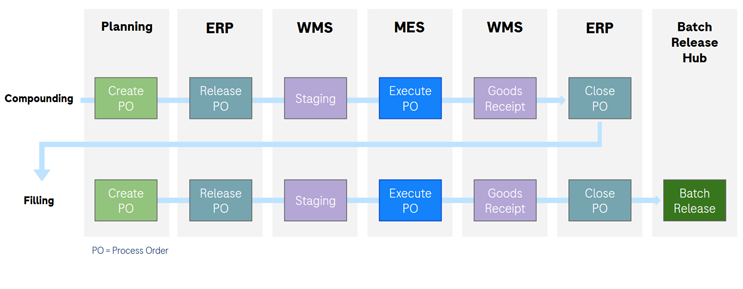
Kläsle: To uncover potential defects well before go-live, conducting comprehensive end-to-end testing across multiple iterations was essential. We validated the entire process landscape, seamlessly connecting the newly introduced ERP, WMS, and MES with existing planning and batch release systems.
End-to-end testing scope
With three interdependent projects likely involving different external and internal leads, how did you structure governance and decision rights?
Von Blarer: With three interdependent projects involving diverse internal and external leads, structured governance was vital to maintain alignment and momentum. Strict, quantitative go/no-go criteria, checkpoints, and milestones across the different projects ensured aligned project progress. Governance, including all local and global stakeholders, preserved transparency on the respective project risks and a clear escalation path. The established governance mantained the support from senior management and fostered the joint review of critical milestones and project risks.
Maheswaren: We established integrated planning schedules, joint gate reviews, and dedicated decision and escalation boards specifically designed to handle both technical and business challenges. Leadership roles were assigned based on trust and proven delivery track records. The governance model was intentionally set up not as a bureaucratic hurdle, but as an active support system to empower teams, fast-track critical escalations, and maintain transparent oversight across all workstreams and regional sites.

What conditions create fertile ground for scope creep? Is it possible to draw the line and delay action on emerging issues?
Von Blarer: Scope extension typically finds fertile ground when requirements are ambiguous and parallel process harmonization relies on undocumented legacy practices, leading to endless feedback loops. To combat this, establishing clear, precise, and business-approved process maps and process requirement specifications reflecting the actual manufacturing process is essential.
Kläsle: A key turning point was co-locating process experts, QA, and recipe designers in dedicated alignment sessions to finalize the process requirement specifications (PRS). This established undivided focus and cross-functional consensus. Having approved PRS documents was defined as a major milestone in the project plan. In parallel, we established clear GxP-criticality criteria to triage emerging issues, effectively separating go-live-critical requirements from post-go-live enhancements.
Describe any friction that happens between global initiatives and local operators on the shop floor. Can you achieve balance between implementing a global template and respecting local practice?
Maheswaren: Balancing global standardization with local shop-floor practices always introduces operational friction, particularly when operators must adapt to three new systems simultaneously. To achieve harmony between the global template and local site realities, we prioritized extensive organizational change management (OCM), train-the-trainer programs, and targeted leadership sessions. Engaging local subject matter experts early, analyzing SOP impacts across hundreds of documents and adjusting in a timely manner, and establishing clear feedback channels ensured that local practicalities were respected without compromising the integrity of the global template.
Can you describe any challenges you encountered during integration testing? Your talk notes a shifting master data set to test against.
Kläsle: Testing in an environment with constantly changing master data revealed that validation and defect fixing are continuous operational challenges. As a core condition for success, we established the requirement for a reliable, production-representative "golden data set" for testing interfaces and core functionalities. Furthermore, we enforced a strict governance process ensuring that any subsequent master data changes were formally reflected in test systems, accompanied by mandatory risk assessments.
Von Blarer: Embedding an ERP master data expert directly into the MES project team was critical for success. Beyond translating system functionalities and preparing and cleansing test data, the master data expert systematically verified and validated the final data loads into the new ERP system, safeguarding end-to-end data integrity.
After the cutover, what happened during the hypercare period, and how long did that heightened level of vigilance last?
Maheswaren: Following a successful cutover, hypercare served as a vital stabilization window, with duration and intensity tailored by system against predefined exit criteria and performance KPIs. Daily stand-ups, cross-functional rapid-response teams, and granular tracking dashboards enabled us to quickly distinguish between operator errors and root-cause system defects.
Kläsle: We leveraged the initial post-cutover water-run phase to resolve critical issues and deploy necessary recipe adjustments ahead of commercial manufacturing. During commercial hypercare, the primary operational challenge was balancing intensive on-site shift support with parallel incident resolution. The vast majority of critical incidents stemmed from interface processes, followed by system performance bottlenecks.
Von Blarer: This heightened level of vigilance is maintained until the systems have reached a stable state and all exit criteria are formally fulfilled. We remained in hypercare as we worked toward the exit gate, scheduled for three months post-go-live.
About The Experts:
 Philipp Kläsle is an manufacturing execution system lead at Roche. Previously, he held executive and leadership roles at Körber Pharma Consulting. He's a co-author of the ISPE's Pharma 4.0 Maturity Assessment chapter of the ISPE Baseline Guide. His undergraduate degree is in computer science and he has an M.Sc. in business information technology.
 Mugunthan Maheswaren is a PMO lead project and portfolio manager at Roche's Kaiseraugst, Switzerland, site. Before joining Roche in 2013, he was an IT support specialist at Applied Materials. He received his Bachelor of Technology degree at Anna University of Chennai and a Master of Science from FHNW School of Business.
 Damian von Blarer is a unit lead for strategic digital initiatives and enabling processes at Roche where he started in 2007 as a media prep operator. Since then, he's held positions at INFORS HT, a biotechnology research company, and the FHNW School of Life Sciences as a scientific assistant, before returning to Roche in 2023 as a manufacturing specialist. He has a Bachelor of Science degree in biotechnology from Zurich University of Applied Sciences.