
MS Structure ID Suite™: Our Most Advanced MS Toolset For Structure Characterization
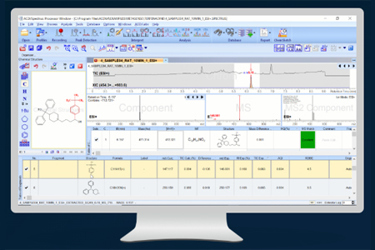
Characterize Samples and Identify Unknown Components
Do you often need to identify unknown compounds from complex samples? ACD/MS Structure ID Suite offers a simple, replicable workflow for generating and narrowing down structural candidates.
- Deconvolute complex LC/MS and GC/MS data into individual component traces
- Search proprietary and commercial databases for spectral matches
- Search PubChem for accurate-mass and molecular-formula matches
- Narrow down candidate structures by retention time and fragment include/exclude lists
Benefits
One Deformulation Workflow for All Your Samples
Extract traces from complex samples
- In two clicks, separate co-eluting peaks by turning your unresolved total ion chromatogram into component extracted ion chromatograms
Identify ‘known unknown’ components
- Search in-house and commercial databases for spectral matches
- Evaluate match accuracy with mirror plots and hit-quality indicators
Increase number of identified compounds
- Don’t have spectra for all the compounds in your sample? Expand the number of compound IDs by using accurate mass and molecular formula to search the PubChem database of > 100 million unique structures
Focus large candidate lists
- Rank candidates by predicted LC or GC retention time, or by correspondence between experimental mass spectrum and predicted fragmentation pattern
Build on your knowledge
- Increase the number of compounds you can identify quickly by building a database from in-house experimental data
How it Works
Sample Deformulation in 4 Easy Steps
- Import your data (in any common format).
- Run the deconvolution and spectral search algorithms to separate components and identify compounds by spectra.
- Choose a component that remained unidentified after spectral search, and generate a molecular formula for it. Search its mass and molecular formula against more compound libraries.
- Report your results and upload them to the shared database.
Product Features
Features of MS Structure ID Suite
- Deconvolution
- Component Characterization
- Data Import and Processing
- Quantitation of LC/UV/MS Data
- MS Fragment Prediction
- Databasing, Reporting, and Integration
- Multi-Technique Data Processing and Analysis
Deployment/Integration Options
Compatible with All Your Instruments and Techniques
We help you put all your data back together again. Your lab probably has MS instruments from many manufacturers, and that’s not counting the NMR, IR, and other analytical equipment. As the leader in vendor-agnostic chemistry software, ACD/Labs partners with dozens of vendors to support > 150 file types and thousands of instruments. So you can use the equipment you need, without worrying about having data in a dozen different formats.
More Reasons to Use MS Structure ID Suite
MS-Based Unknown Characterization
Mass spectrometry is one of the most widely used techniques for unknown characterization. It offers broad applicability, easy integration with separation techniques, and low limits of detection. But digging through the ensuing data is difficult—especially for complex samples.
First, the signals must be separated into different components. Though chromatography can separate peaks, complex samples will often have many co-eluting species, which must be teased apart based on their spectra.
Then each component must be identified, usually by spectral match, though fragmentation pattern can be used if fragmentation is relatively predictable (as for proteins). Components contained in spectral libraries will be identified in this manner. Components with no library spectra won’t produce candidate hits. MS Structure ID deals with these components using formula generation, formula-and-mass search, and filtering via retention time or fragment match.