
Optimizing Your Manufacturing Process Using Comprehensive Powder Characterization
Tim Freeman, Managing Director, Freeman Technology, A Micromeritics Company
Powders are complex materials utilized in many different applications and exist as various forms of final products. They exhibit a range of behavioral characteristics, and these characteristics influence the powder’s performance within the processing environment as well as the attributes of the finished product. Understanding this behavior through measurement of the most appropriate properties is essential for efficient processing and consistently high-quality finished products.
Understanding The Complexity Of Powders
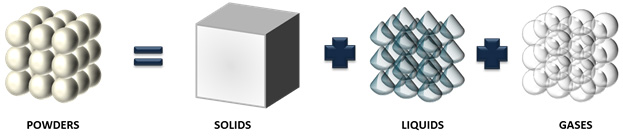
Powders are complex, bulk materials made up of solids, which are the particles themselves; liquid, which is either on the surface of the particle or within the particle; and gas, which is normally air between the particles (figure 1). The powder's bulk characteristics will depend on how these three phases interact. Each powder particle is complex and has a series of physical and chemical attributes. Particle size and size distribution within a powder is well understood and recognized as being important, but other properties, such as shape, surface texture, surface area, etc., have the potential to contribute to how the powder behaves and its overall bulk characteristics. For example, when a pair of smooth spherical particles interact, they will slide or shear relative to one another without significant resistance. However, if their roughness changes, there is a greater level of resistance and the ability of a particle to move or shear relative to its neighbor is reduced. If the shape of the particle changes, the propensity for mechanical locking increases, and this has an impact on bulk powder behavior.
Powder behavior is a function of particle size, shape, stiffness, porosity, surface texture, density, cohesion, and adhesion, but environmental conditions also impose different levels of stress either via consolidation or aeration. The extent of shear and strain imposed on the powder may also influence how it behaves, as well as how that material interacts with the surface properties of the processing and handling equipment. There is no mathematical model that enables prediction of how a bulk powder behaves in every process environment just by considering its primary particle properties. However, it is important to make every effort to gain a good understanding of a powder’s behavior, as this will help with designing an efficient and consistent manufacturing processes.
Understanding how a material behaves within a processing environment and what variability in those material properties can be tolerated by the normal processing environment also allows you to identify where the threshold is and where problems may occur. The same is true if you want to start involving functional benefits or critical quality attributes of the finished product as well as process configurations
and decisions. Being able to anticipate variability in your manufacturing process gives you better control over product quality, preventing significant costs and interruptions that are a consequence of surprises during the handling and processing of your materials.
The Power Of Knowledge: Designing With Quality In Mind
Historically, product and process development were completed by segregated groups, with formulators developing a final commercial formulation separate from the chemists and engineers designing the large-scale manufacturing process. Because the physical and chemical properties directly impact formulation attributes, characterizing them in early phase, and sharing that information with those designing the manufacturing process helps avoid larger scale challenges. If an effort is made to instead understand material properties at all scales, the variables of interest can be manipulated in order to make the best product, both in terms of its functional performance and manufacturing operation. The most relevant approach to characterization is one where you can measure the powder in a way that replicates the environment in which it will be handled and processed. Doing so gives you a better chance of finding differentiation between two materials that behave differently in the specific industrial environment.
Another important factor to keep in mind is that there is no such thing as a “good” or “bad” powder. This common misconception is a trivialization of what is actually a complex equation between matching the material’s properties to the specific process. Whatever powder you are using must have characteristics that suit the specific application for which it is being designed. A cohesive powder with apparently “poor” flow properties may end up performing more consistently in a filling process if, for example, the equipment is designed for a powder with those characteristics.
Encouragement from the FDA over the last 15 years to understand material properties earlier in the product lifecycle and within manufacturing has led to the implementation and acceptance of initiatives, such as Quality by Design and Process Analytical Technology (PAT). While there is not a fundamental understanding of how to relate particle properties to final product attributes or particle properties to bulk powder behavior, the ability to measure powder bulk properties relevant to the process, performance, or the finished product quality is of absolute value to the manufacturer. For example, flow measurements can be used to predict things like fill weight consistency, propensity for segregation, or a sensitivity to moisture, so you can design a control strategy around these parameters. Designing a process with these considerations, though, requires appropriate and effective powder characterization methods.
Characterizing Your Powder
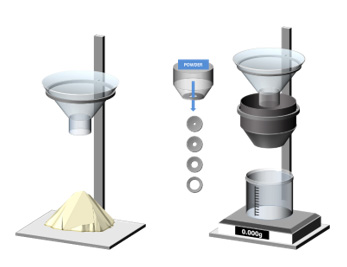
Current powder characterization methods have evolved substantially from 20 years ago, when only a couple of empirical tests were performed, such as angle of repose or flow through an orifice (figure 2). These types of tests define some attribute of the powder behavior but do not control or investigate other factors, such as variations in stress, i.e., how much compaction the powder might be under in a particular process. If the material is subject to compaction before the test, the measurement may not be relevant to the actual industrial application. Today, manufacturers recognize that powders in any given process are subjected to different levels of compaction or, at the other extreme, aeration. For example, if a beaker of powder is shaken, air permeates between the particles and the powder becomes loosely packed. If that same beaker full of powder is tapped, it consolidates and densifies. The powder is the same powder in the sense that the particles still have the same properties, but the bulk behavior is significantly different.
If you do not design your experiments and measure attributes that are “process relevant”, industrially or from an application perspective, then it is unlikely you will capture the information relevant to the specific problem you are trying to address. Modern technologies are now available that characterize the material under a range of different conditions. This stems from the knowledge that a single number is simply not going to represent what that powder might experience as a set of stress conditions within the process environment. It is also critical to assess the sensitivity of the material to different flow rates or shear rates, as these variables are unavoidable within a manufacturing process.
Understanding how a powder’s characteristics change under specific conditions provides insight into real-life scenarios that could affect product performance. For example, what happens to a powder in a dry powder inhaler when the device is carried around throughout the normal course of a day? Is there a potential for consolidation or moisture ingress that could change how the particles interact and, ultimately, how that powder behaves? Rationalizing the source of any risks and then being able to characterize the material’s sensitivity to those risks gives you the best chance of designing a system that mitigates chance of any variability and ensures high product quality and patient safety is achieved.
 Tim Freeman is Managing Director of powder characterisation company Freeman Technology for whom he has worked since the late 1990s. He was instrumental in the design and continuing development of the FT4 Powder Rheometer® and the Uniaxial Powder Tester. Through his work with various professional bodies, and involvement in industry initiatives, Tim is an established contributor to wider developments in powder processing.
Tim has a degree in Mechatronics from the University of Sussex in the UK. He is a mentor on a number of project groups for the Engineering Research Center for Structured Organic Particulate Systems in the US and a frequent contributor to industry conferences in the area of powder characterisation and processing. A past Chair of the American Association of Pharmaceutical Scientists (AAPS) Process Analytical Technology Focus Group Tim is a member of the Editorial Advisory Board of Pharmaceutical Technology and features on the Industry Expert Panel in European Pharmaceutical Review magazine. Tim is also a committee member of the Particle Technology Special Interest Group at the Institute of Chemical Engineers, Vice-Chair of the D18.24 sub-committee on the Characterisation and Handling of Powders and Bulk Solids at ASTM and a member of the United States Pharmacopeial (USP) General Chapters Physical Analysis Expert Committee (GC-PA EC).