
Recommended Mixing Equipment For Pharmaceutical Gels
By Christine Banaszek
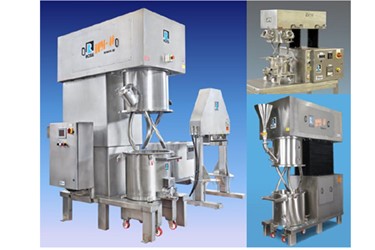
Hydrogels based on natural polymers (like starch, alginates, guar gum and carrageenan) and synthetic polymers (such as polyvinylpyrrolidone, polyacrylic acid and polyethylene glycol) are widely used in wound care, drug delivery, tissue implants, cosmetic, dental and many other applications.
Efficient and thorough blending in a well-designed Double Planetary Mixer is an ideal method for preparing high-purity hydrogels with superior batch-to-batch consistency, short cycle times and minimal clean-up.
Ross Double Planetary Mixers
Double Planetary Mixers (DPM’s) are well-proven for the processing of hydrogels. In traditional DPM’s, batch materials are mixed by two rectangular-shaped paddles that rotate on their respective axes while orbiting on a common axis. The blades contact virtually every point of the batch in just 36 revolutions, imparting a very thorough but gentle blending and folding action.
While the classic rectangular agitators are capable of handling a wide variety of viscous applications including hydrogels, a newer helical blade design offers improved mixing accuracy. The Ross High Viscosity “HV” Blades (US Patent No. 6,652,137) feature a precisely angled contour which generates a unique mixing action: the sweeping curve firmly pushes batch material forward and downward, keeping it within the mixing zone at all times. This agitation mechanism is ideal for viscous and tacky hydrogels that have a tendency to climb up the gearbox when stirred with rectangular paddles. The HV blade design eliminates this issue, delivering huge improvements in mixing efficiency, clean-up time, product purity.
A sample hydrogel mixing procedure on the DPM begins with loading water and glycerine into the vessel. After a short mixing run, the blades are raised from the batch, powdered polymers are charged on top of the liquid and vacuum is established prior to resuming agitation. Solid ingredients are normally added in increments; pulling vacuum during each step helps to prevent air between the dry particles from becoming micronized as the batch transitions into a thicker consistency. In some cases, minor ingredient additions can be done through a sight port on the mixer cover as the blades are running. This is applicable to formulations that readily let go of entrapped air once the mix chamber is brought to 29.5”Hg. Finished product is pushed out of the vessel via a discharge platen.
Some Advantages of Ross Double Planetary Mixers with High Viscosity “HV” Blades
Enhanced mixing accuracy. The helical High Viscosity Blades prevent batch materials from ‘climbing’ up into the mixer cover and gearbox, an issue commonly experienced with conventional rectangular planetary stirrers. Another important feature is the flush discharge valve which eliminates any dead spots where batch materials can stagnate.
Flexibility. The DPM is one of the most versatile pieces of processing equipment. It does not require a minimum liquid level to properly wet-out and disperse solids. This mixer can handle pastes and dough-like materials as easily as it can prepare granulations. The DPM can also be used for vacuum drying and transforming wet cakes or slurries into free-flowing powder.
Cleanability. There are no shaft seals, bearings, packing glands and stuffing boxes submerged in the product zone of the Double Planetary Mixer. Agitators are raised and lowered by a hydraulic lift allowing easy access for cleaning between batches.
Change can design. Interchangeable mix cans may be designated to particular formulations. This feature further reduces the risk of cross-contamination between batches while allowing for semi-continuous operation when one mixer is used with multiple vessels.
Fast and easy discharge. With the mix can positioned beneath a Ross Discharge System, a platen is lowered hydraulically into the vessel. A fitted O-ring rides against the vessel, wiping the sidewall surfaces on its way down as product is forced out by the platen. The Discharge System eliminates wasted hours of scraping heavy or sticky materials from the mix vessel.
Other Sanitary Applications of Ross Double Planetary Mixers:
- Bone Graft Substitutes
- Collagen Solutions
- Dental Composites
- Filled Polymers
- Implant Materials
- Medical Adhesives
- Silicones
- Ointments
- Pharmaceutical Cakes (Mixing and Vacuum Drying)
- Tissue Substrates
- Toothpaste
- Viscous Foods
- Wet Granulations