
Recovering VOCs
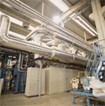
Air-quality regulations like the 1990 Amendments to the Clean Air Act (CAA) have significantly restricted use of solvents, especially volatile organic compounds (VOCs). Yet for many demanding industrial applications, solvents remain essential. In such cases, the challenge is to continue using solvents safely and effectively without creating environmental concerns.
In many instances, using activated carbon can alleviate the immediate concern, which use, however, can create concerns of its own.
Activated-Carbon Adsorption
Activated carbon, in widespread industrial use since the end of World War I, was by the mid-1970s the preferred choice for air-pollution control of VOCs because of its selectivity in removing organic vapors from gas streams even in the presence of water.
The conventional carbon-bed adsorption system—one relying on team regeneration—can be an effective technique for recovering solvents for their economic value. Adsorption occurs when a solvent vapor comes into contact with a carbon bed and is collected on the porous activated carbon surface.
Carbon-bed adsorption is effective in solvent-recovery operations at solvent concentrations above 700 ppmv. Because of ventilation requirements and fire codes, the normal practice has been to keep the solvent concentrations below 25% of the lower explosive limit (LEL).
Carbon-Bed Resuscitation.
Over time, the carbon bed will accumulate solvent, become saturated, and require regeneration (solvent removal) so that it can be returned to effective use.
The most common way to recover solvent from saturated carbon beds is to use low-pressure steam. After solvent has been steamed from the activated carbon, the resulting steam-solvent mixture is condensed, and solvent is decanted from water.
Although highly effective, this conventional carbon-bed adsorption technique does have an inherent environmental drawback. By-product water resulting from the steam-condensation process is likely to be contaminated. In effect, although an air-quality-control problem may be corrected, a water-quality control problem may be created. Downstream procedures—such as distillation or scrubbing techniques—may have to be undertaken to separate the organics from the wastewater stream. Also, stringent water-quality regulations generally require that the water then go through further (usually costly) treatment before it can be discharged.
Condensation
Another solvent recovery technology, condensation, avoids a wastewater problem. With condensation, VOCs are liquefied and removed from gas streams. This change occurs by dropping the temperature of the solvent-laden stream below its dew point at constant pressure, or by raising the pressure at constant temperature.
The conventional condensation approach uses mechanical refrigeration to recover solvents in an air atmosphere. For solvent recovery, mechanical refrigeration systems are recognized to be as serviceable as carbon-adsorption systems. In fact, they yield a cleaner solvent for recovery. Mechanical refrigeration is also considerably more energy intensive, however.
Using mechanical refrigeration in combination with air requires a dilute stream, which is not the optimal approach for condensation. With this approach, large amounts of recirculated air are required to stay below the LEL. Everything—including recirculation ducting and the process lines to the recovery device—has to be large-scale. This means a magnetic tape manufacturer has to process large amounts of dilute solvent-laden air to recover minute amounts of solvent.
The primary drawback of mechanical condensation with an air atmosphere is the inability to meaningfully increase the concentration of solvents in a recovery stream. Use of an inert atmosphere like nitrogen, in conjunction with mechanical refrigeration, makes possible the tolerating of higher solvent concentrations. The disadvantage is high operating costs.
Better still, is having the same nitrogen serve both for refrigeration (with the vaporization of liquid nitrogen) and provide the inert atmosphere.* This conserves the volume of nitrogen required to recover the same amount of solvent. Another benefit is that a manufacturer can significantly shrink the size of any recirculation ducting and process line into the recovery system.
*Airco's ASRS (Airco Solvent Recovery System) is a closed-loop condensation solution. The technology is described in the presentation from which this article was adapted, "Case Study—Assembling Systems To Optimize Volatile Organic Compound Recovery." Airco's technology also can serve in a hybrid setup comprising activated carbon and condensation systems. Thus are VOCs are "washed" from the activated carbon by a hot nitrogen stream. They then are condensed from the gas stream.
About the Authors
Irvin A. Jefcoat is a professor in the Chemical Engineering Department at the University of Alabama. Michael Heil is program manager of Solvent Recovery Systems at Airco Industrial Gases in Murray Hill, NJ.