
Root Cause Investigation Into A Possible Container Closure Integrity Failure
Source: Lighthouse Instruments

Background:
- A complaint from the market about a defective pharmaceutical sample will trigger a root cause investigation.
- Complaint product samples are often returned because of a visible defect either in the container or packaging, or because of an issue with the product itself such as discoloration.
- Laser-based headspace analysis is a useful tool for determining if container closure integrity is an issue, or for the case where the formulation can degrade in the presence of reactive headspace gases.
Customer complaint:
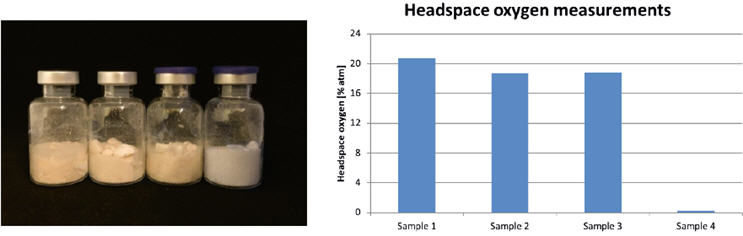
- Three complaint lyo product samples were delivered for analysis due to discoloration of the product.
- Headspace oxygen levels were analyzed in each sample and in a control vial from the same batch.
- The three discolored samples showed atmospheric levels of oxygen instead of the specified nitrogen headspace.
Conclusions:
- The discoloration of the three complaint vials correlated directly to elevated oxygen levels in the headspace.
- The root cause of the elevated oxygen levels was determined to be a container closure integrity (CCI) issue.
- An additional non-destructive headspace CCI test showed that the complaint samples were well sealed at the time of the test. This further information led to the conclusion that the issue was a temporary one and most likely happened during the manufacturing process.
The LIGHTHOUSE method for non-destructive headspace analysis is a useful tool for root cause investigations into possible container closure integrity issues or for cases where the formulation can degrade in the presence of reactive headspace gases. In cases where oxidation of the formulation causes discoloration and eventual degradation of the product, non-destructive headspace analysis tests can give deep insight into the root cause. Since the samples are not destroyed by the headspace analysis, further testing can be done to accurately correlate headspace conditions with other product characteristics.