
SemBioSys, Novartis Agricultural Join on Protein Product Development
Oleosin Technology
Broadly Applicable to Peptides, Proteins
About the Partners
SemBioSys Genetics (Calgary, AB, Canada) has signed a multi-year product development agreement with Novartis Agricultural Discovery Institute Inc. (NADII). Under terms of the agreement, NADII will fund the development of a proprietary product addressing nutraceutical, cosmeceutical, and pharmaceutical markets, to be developed using SemBioSys' proprietary oleosin system. SemBioSys will supply the product to NADII, who will have exclusive rights to the product. Financial terms were not disclosed.
SemBioSys' proprietary oleosin technology is based on genetically engineering oilseeds to produce value-added proteins. These proteins are attached to oilbodies, liposome-like organelles found in oilseeds. SemBioSys has the ability to extract the oil body/protein assembly cost-effectively using its proprietary processing technology. The oil body/protein assembly can then be used directly in applications where the emulsion characteristics of oil bodies enhance formulation or delivery, such as in food and cosmeceutical applications.
"The agreement with NADII is a further validation of the utility of our technology" said Andrew Baum, SemBioSys' president and CEO. "We are especially pleased to be working with NADII, as they bring complementary technology and outstanding expertise in plant biotechnology."
"SemBioSys technology is uniquely suited to the product we are developing," said Steven Briggs, NADII's president and CEO. "It is attractive because it allows the development of applications and formulations that would otherwise be difficult or uneconomical to achieve."
Oleosin Technology (Back to Top)
SemBioSys's oleosin technology exploits the attachment of oleosin proteins to oil bodies in seeds. By engineering the seed to produce a fusion between the oleosin protein and a commercially desirable protein, oleosin is a potential route to low-cost commercial proteins. The reason is that the oilbody/fusion protein assembly significantly reduces the cost of protein purification.
During purification, transgenic seed is ground up and mixed with water, and the oilbody assembly is separated from the resulting mixture by a proprietary low-cost system developed by SemBioSys. The target protein is then cleaved from the oilbody assembly using one of several chemical, mechanical, or enzymatic mechanisms before final purification. By addressing purification as well as bulk protein production, SemBioSys' system is ideal for the production of highly purified proteins where cost is an issue.
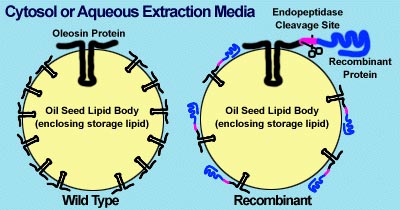
Beyond low cost, the oilbody/protein fusion assembly system offers a potentially unique system for delivering proteins. Oil bodies can be used as ingredients for both topically applied products (including pharmaceutical and personal care ingredients) as well as foods and nutrients. SemBioSys's added value is both a low-cost source of products and a delivery system for food, personal care and topical drug formulations.
SemBioSys' production and purification system works in a variety of oilseed crops. More than a dozen proteins have been produced using the oleosin system, including pharmaceuticals, enzymes, vaccines, and animal feed additives.
Broadly Applicable to Peptides, Proteins (Back to Top)
Most pharmaceutical materials produced through the oleosin process are proprietary, but the available list of peptides and proteins is impressive. "We can manufacture anything from peptides 13 amino acids long up to 100 kD," Baum told Pharmaceutical online. "So far we've made small cytokines, fish growth hormone, and reporter enzymes, as well as a few industrial enzymes. Our technology isn't limited to simple peptides, either. It allows for synthesis of complex tertiary structures, including disulfide bridges."
Other companies use natural production methods for protein. For examle PPL Therapeutics, Genzyme Transgenics, and Nexia use transgenic goat milk to produce therapeutic proteins. Several dozen companies use plants as protein factories; a few use insect tissue culture. All these natural production systems require extensive downstream processing, including costly chromatography steps. Purification, in fact, accounts for as much as 80% of the cost of producing recombinant proteins.
SemBioSys has the advantage here, since proteins are produced in relatively pure form. Purification involves little more than separating fats from water, a technology that is well-established in the food industry.
"Not only do we make proteins inexpensively, we address purification as well," Baum added. "Remember our target proteins are attached to an oil body. Using simple dairy industry equipment, we can separate the protein from the oil body really inexpensively. The resulting protein is already basically pure. Our system changes the cost dynamic of downstream purification and converts a batch process into a continuous one while eliminating nearly all the chromatography steps. For example we were able to reduce the number of chromatography steps in the production of hirudin, a blood coagulant, by 60%. We're onto something very unique here."
About the Partners (Back to Top)
NADII is funded by the Novartis Research Foundation, an independent research foundation that was established and funded by Novartis. Novartis is a world leader in healthcare with core businesses in pharmaceuticals, consumer health, generics, eye-care, and animal health. In 1998, the Group (including Agribusiness) achieved sales of $21.8 billion and invested more than USD $2.6 billion in R&D. Headquartered in Basel, Switzerland, Novartis employs about 82,000 people and operates in over 140 countries around the world. NADII recently announced plans to spin off its Crop Protection and Seeds sectors and to merge them with the agrochemicals business of AstraZeneca in the second half of 2000.
SemBioSys is a Calgary-based biotechnology company focussed on the development of high value protein and oil body based products using its proprietary oil body/oleosin technology. The company, based on technology developed by scientific founder Maurice Moloney, was spun-out of the University of Calgary in 1996. Major shareholders include Moloney, University Technologies International Inc. and Dow AgroSciences Canada Inc.
For more information: Andrew Baum, CEO, SemBioSys Genetics Inc., 500, 3605-29 St. N.E. Calgary, AB, Canada T1Y 5W4. Tel: 403-250-5424, ext. 24. Fax: 403-250-3886.
By Angelo DePalma