
Simple Temperature Indicators Aid New Drug Production
Simple Is Best
Convenience Is Key
Simple Is Best (Back to Top)
A major NJ pharmaceutical company found, for example, that engineers could double-check instrument readings using simple handheld temperature indicators. This company has developed an easily scalable, patented process for increasing protein production at a fraction of the cost of competing methods. Their major product, used to treat osteoporosis, is a naturally-occurring protein that assists in maintaining healthy bone mass.
The process substitutes a fermentation for more costly, time-consuming chemical modification of the protein. Most of the fermentation vessels at the facility are stainless steel, ranging from 4- to 1500-liter capacity. Batch production begins with cleaning and sanitizing the vessel, introducing the media, and following an automated program for steam in place heat/pressure sterilization which is checked by RTD and pressure indication.
After each batch is isolated the vessel is cleaned, and the empty vessel sanitized to FDA requirements to reduce bioburden before the next production run begins. During sanitization the vessel is heated to 121° C (250° F), as indicated by an indwelling temperature measuring device. Hand-held Tempilstik temperature indicators are used to confirm or verify that different parts of the vessel and various pieces of ancillary equipment—valves, piping, etc.—have reached or exceeded the required sanitizing temperature.
Subsequently, a second Tempilstik indicator confirms that the vessel's surface has cooled to below 100° C, reducing its internal pressure to the point where the next batch of media may safely be introduced. In vessels that are air-cooled after steaming, a Tempilstik crayon indicates when the air should be turned off (since the vessel has reached the temperature point where steam will no longer condense and draw a vacuum).
Convenience Is Key (Back to Top)
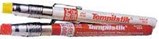
Tempilstik temperature indicators, supplied by Tempil Inc. are an accurate and convenient way to determine when any desired specific temperature has been reached. The temperature indicators, made of materials with melting points calibrated to close tolerance, undergo a solid to liquid phase change at various exact temperatures. Tempil offers Tempilstiks in 103 temperature ratings, with melting points spaced between 100° F (38° C) and 2500° F (1371° C).
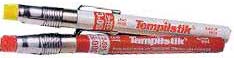
Tempilstik are supplied in stick form, resembling mechanical pencils. An indicator is simply stroked on the piece of equipment to be temperature-checked. If the temperature is at the indicator's rating or higher the mark immediately liquefies—a positive indication that the desired temperature has been reached. When the 100° C (212° F) stick mark does not liquefy, that is an indication that the vessel surface has cooled below that temperature point.
Since the indicators are easily applied anywhere, operators have no difficulty testing various points on the vessel wall, valve and piping. The indicators make positive contact, so there is no question that the temperature they are measuring is the temperature of the surface of the vessel. Indicator materials reach thermal equilibrium rapidly with no instrumentation delay, and they do not conduct heat away from the surface being tested.
Unlike instruments, the indicators never require calibration. If one is dropped there is no damage or recalibration to deal with. And, of course, their cost is modest on a per-use basis compared with any form of instrumentation.
Laboratory operators applying Templistik on the surface of vessels or equipment to confirm exact temperature reading report finding that Templistik gives them greater insight into vessel temperatures than would be gained by solely relying on line temperature as tested at one part of the vessel.
For information: Dennis Redline, Business Development Manager, Tempil, Inc. 2901 Hamilton Blvd, South Plainfield, NJ, 07080. Tel: 800-757-8301. Fax 908-757-9273.