
Single Use Equipment: Disruptive Innovation
By Mona Akerholm-Kaapro, Elomatic
It has been suggested that as a result of improved technologies it will, in some years, be possible to analyze the complete human genome for only 1000 USD. This will enable members of the public to access their most basic building blocks for a sum of money that not so many years ago would have seemed laughable.
How does this affect Elomatic, an engineering company that, amongst others, provides solutions for new production facilities and renewal of existing facilities?
Personalized drugs just around the corner
 To find the answer one has to assess how the above changes will affect the pharmaceutical industry as a whole. In a nutshell, the new cheaper genome analysis techniques will have a profound and paradigm shifting effect on production within the industry. Drugs will become increasingly personalized, whic h means smaller production batches and production facilities. At the same time governments will invest more money in preventive actions to indetify specific treatments for predicted diseases.
It remains to be seen whether this process will result in vast decreases in the production of painkillers and other com- man drugs. What is certain, however, is that it will be a lengthy process.
Many avenues are being explored to efficiently produce personalized drugs. Some companies are building small production units adjacent to hospitals in order to use patients' own blood for drug preparation. Others are investigating ways of increasing the absorption rates of active ingredients.
Another approach is the modification of genes in micro-organisms to make them cure deseases. An example of this is vaccine production. These micro-organisms need a bio-reactor in order to be cultivated in sufficient numbers to be efficiently applied. Another interesting and promising trend on the market is the utilisation of single-use components as bioreactors and in downstream purification processes.
Disposable equipment
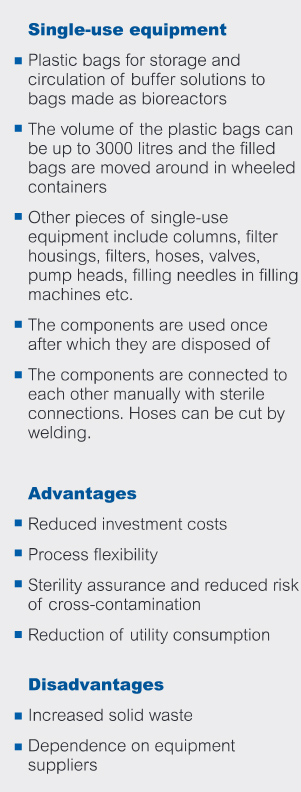
As the name suggests, single-use equipment is used once and then disposed of. The equipment and components can either be tailor-made or standard delivery. The availability of single-use equipment and components is growing rapidly and has forced unit prices down. In addition the usability and reliability of these systems has increased markedly.
A closer look at the advantages and disadvantages of single-use production sheds light on why it is increasingly being seen as a possible future standard in pharmaceutical drug production.
Lower investment costs
Setting up a traditional pharmaceutical production facility that houses stainless steel components requires a substantial investment. Not only are the components costly, but such a facility requires extensive design and construction work for equipment, tanks, pipes and components. Pharmaceutical producers are also obliged to test and validate all components in order to show that the facility is valid for its intended use.
The investment required for single-use equipment, on the other hand, is significantly less than for a stainless steel factory. The plastic bags and components are cheaper than stainless steel equipment and their cost can be dedicated to each batch produced. The facility still has to be built or modified for the single-use production process, but due to the smaller space requirements the investment cost will be smaller compared to the stainless steel alternative. The hours spent on validation can also be decreased as no cleaning and sterilization is needed.
Process flexibility a key resource
Single-use equipment systems are more flexible than their stainless steel counterparts as they can be manually connected in several different configurations. The flexibility of stainless steel systems can also be increased with coupling panels and automation, but permanent pipes or dedicated hoses are nevertheless required. One drawback of single-use equipment is the increased risk of incorrectly connecting the equipment with plastic hoses. This risk can however be mitigated by using barcode readers and systems that ensure that the right connections made. Measurements of critical process data for single-use equipment are obtained in the same way as with stainless steel systems; by connecting the necessary measuring probes to the appropriate ports.
Sterility assurance and reduced risk of cross-contamination
Sterilization of stainless steel components is a relatively labour intensive and time consuming task. The components are first cleaned in place (CIP) with detergents and clean water and then sterilized in place (SIP) with clean steam. Extensive testing is also required to ensure that the existing methods of cleaning and sterilization are sufficient at all times. Single-use components, by contrast, are delivered pre-sterilized to the facility (usually with gamma irradiation offsite) and are ready for use immediately. The risk of cross-contamination in single-use components is also lower due to the absence of residues from former batches.
Reduction of utility consumption leads to significant savings
The reduced footprint of single-use components is augmented by the fact that the clean room grade required (ranges from grade D to A) is also reduced to grades D and C (ref 2). The fact that single-use components require less space not only decreases the investment cost for the building, but also the cost of ventilation and thus heating, cooling and electricity. A reduction of up to 29 % in electricity consumption for the HVAC system has been reported (ref 1 ).
As no CIP is required for single use components the system uses up to 87 % less water for injection (WFI) (1). In addition to providing further savings it may also mean that no WFl-system will be required at all, thus eliminating the investment and the life cycle cost of the entire system. The small amounts of WFI required can be purchased in single-use plastic bags that can be used directly in the process.
Solid waste a potential problem
The greatest obvious disadvantage of singleuse production is the generation of additional solid waste. After possible deactivation, all components that are to be disposed of have to be transported to an incineration facility (in most cases). This additional transport need will increase the carbon footprint of the facility to a certain extent, depending on the proximity of the incineration facility. In some cases the incineration process can, however, result in energy savings if the facility uses the energy generated from burning waste to produce heat or electricity. It is also likely that the recyclability and separability of single-use materials will improve and thus decrease waste generation.
Can we condclude that single-use equipment is the latest world saver?
A review of available evidence indicates that it is indeed possible to achieve more environmentally-friendly production by implementing single-use equipment. In short, the utilisation of single-use production should be encouraged. Single-use components are not suitable (not yet anyway) for all kinds of biopharmaceutical production, but the technology is evolving rapidly. Other bio-production industries are also now assessing the viability of singleuse components in their processes.
Effects of single-use components on engineering
Patient safety has always been and will remain the number one priority in pharmaceutical production. This means that risk assessments will have to be conducted by experts to measure the suitability of single-use equipment. Particular attention needs to be paid to identifying extractables and leachables from plastic components into the produced liquids (ref 2). In general, however, it is expected that single-use components will be very well suited to most forms of biopharmaceutical production.
The smaller-sized facilities and reduced utilities will naturally require less engineering for planning and construction. It is, however, likely that more facilities will be constructed around the world in different locations as opposed to the current trend with a few large facilities for generic production. Engineering companies will, therefore, have to keep pace with developments in order to align their service offerings with the changing demands of the market and environment.
Finally, any decrease in the impact of human operations on the environment is of benefit to us all.
References
1. Andrew Sinclair, Lindsay Leveen, Miriam Monge, Janice Lim, Stacey Cox: The Environmental Impact of Disposable Technologies. BioPharm International. November 2008
2. Helene Pora and Bruce Rawlings: A User's Checklist for Introducing Single-Use Components into Process Systems, BioProcess International, April 2009
Mona Akerholm-Kaapro
M.Sc. (Process Engineering)

Ms Akerholm-Kaapro holds a Master's degree in Process Engineering from Abo Akademi University (1997). Since graduating she has worked in process and facility design as well as project management with pharmaceutical customers around the globe.
Ms Akerholm-Kaapro currently works as a Sales Manager in the Elomatic Turku office. mona.akerholm-kaapro@elomatic.com