
Understanding And Solving Segregation Effects In Pharmaceutical Solid-Dosage Form Operations
Segregation of powder and granular mixtures is a costly problem in the pharmaceutical industry. Most manufactured products are mixtures of several components. Often the ingredients in a mixture separate (segregate) during processing, resulting in an inconsistent final product. Understanding segregation and how it is related to drug development cost is at the heart of solving this issue and is the topic of this article.
In the pharmaceutical industry, it is not uncommon for segregation issues to reduce the viable product created in a given batch to 70% of the total amount of material created (15% from the start and 15% from the end of the batch run). This is a significant loss of usable product and considerable revenue drain, especially since bulk drugs are often very costly. However, loss of usable product may not be the biggest cost factor resulting from segregation problems. Product segregation also leads to validation failure due to a presumed inability to control the process to create product with the required content uniformity (CU) range. These are serious issues and, if excessive, can ultimately prevent a product from coming to market. Delaying time-to-market results is a significant liability to pharmaceutical companies. Even a six-month delay in getting the drug to market could cost a pharmaceutical company over $1,000,000,000 ($1 billion).
Segregation is one of the three main causes of process failure in systems that handle powder materials. It is a global problem, affecting all industries, and conservative estimates suggest that 30% of all unscheduled processing downtimes are due to segregation and resulting quality issues.
There are many steps in the drug development process including formulation development, toxicology studies, stability tests, animal trials, human trials, production process selection, production process validation, and finally commercial production. The formulation development, process selection and process validation are often quite late in development cycle. Formulators must design the solid dosage form to achieve the right compressibility, density and friction to assure reliable tableting or capsule filling. However, formulators must also design the drug to minimize the segregation during the blending and tablet production process.
Failure to consider segregation potential during the formulation stage can significantly delay time-to-market, which in turn increases the development cost of the drug. In some severe cases, segregation potential may make production of viable product impossible. The good news is that, even if the drug formulation has some moderate potential to segregate, selecting or designing the right process equipment can be key to preventing or minimizing segregation. Conversely, selecting the wrong equipment can lead to extensive segregation problems. Process engineers must make sure the process can reliably feed a non-segregated product to the tablet die cavities with a uniform density and weight.
These segregation issues can be solved. However, formulators and design engineers must first understand the magnitude of segregation, the segregation pattern, and if possible, the root causes behind segregation. Segregation can occur if fine particles sift down through a matrix of coarse particles, as fine particles are preferentially carried by air currents to other parts of a process vessel, as materials with two or more distinct particle surface friction characteristics slide down a pile at different velocities, or as a powder becomes fluidized and gas velocities carry lighter or smaller particles to the top material surface. The motion of the bulk powder blend through any mixing, tableting, capsule filling, storage, or packing process can result in stimulus that may separate particles. Pile formation and/or air currents are present in many of these process steps. Fluidization can also occur during these process steps. Thus, there may be a significant risk of segregation during processing and packing.
The first line of defense against this issue is to characterize the segregation potential. Not all mixtures segregate, so measurement of segregation potential is very valuable in pre-production situations as a guide to optimizing the process or the product so as to satisfy content uniformity constraints for the product. Segregation potential measurement is also useful in post-production situations and can be used to determine if the batch created will pose a segregation risk in the final and validated process.
The SPECTester, is a unique instrument that can aid in the measurement of segregation risk for a mixture comprised of up to 6 unique components. The test technique can be done in just 10 to 30 minutes. Data from the test procedure can be used to determine the segregation magnitude and segregation pattern expected during the filling/emptying of a processes or in processes subject to fluidization effects. The formulator uses the results of this test technique to determine the best method to modify the formulation so as to prevent or limit the segregation. The process engineer uses the results of the segregation test method to select or design process equipment best suited to prevent segregation of the drug formulation. This team of formulators and process design engineers, equipped with the SPECTester as their guide, can significantly reduce time-to-market during the pre-production or pilot operations.
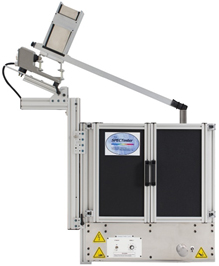 The SPECTester’s ability to analyze mixture samples of multiple ingredients is significant because it can be used not only during the formulation process, but also on the production line as a quality control measure. It supplies information not only about WHAT a mixture is doing in the processing system, but WHY it is behaving this way. This is important because, to design an optimal production system and/or product, engineers and formulators MUST understand how a mixture of ingredients will interact with the process to form the desired final product
Without The SPECTester: Process Engineers wait two, four, or more weeks, outsourcing testing to CRO laboratories, for answers concerning the how and why of product segregation issues.
With The SPECTester: In less than 30 minutes, the SPECTester, a revolutionary technological testing breakthrough, answers the quality control questions – what, where, when, how, and why products segregate in the process system – On-site and in real time.