![[VIDEO] GLP-1 Manufacturing's New Bottlenecks At Multi-Ton Scale](https://vertassets.blob.core.windows.net/sites/logos/pharm.png)
[VIDEO] GLP-1 Manufacturing's New Bottlenecks At Multi-Ton Scale

By Katie Anderson, Chief Editor, Pharmaceutical Online
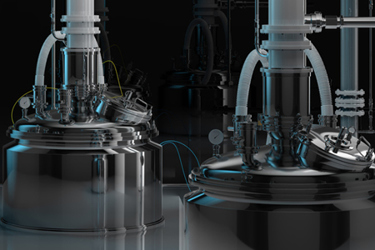
After shifting to accommodate the GLP-1 growth in the past five years, the pharmaceutical industry must continue to strategize and innovate to accommodate the rapid growth that is still projected into 2030. Moving from kilogram-scale production to multi-ton output requires not only adjustments to manufacturing processes, but also adjustments to operations, infrastructure and analytics.
During the Pharmaceutical Online live panel “Analytical Strategies for High-Volume GLP-1 Manufacturing,” Matteo Villain, Vice President of Peptide & Oligonucleotide Strategic Initiatives at Veranova, and Leonardo Costa Siqueira, U.S. API Manufacturing Lead at Novo Nordisk, discussed what changes when peptide manufacturing moves into true industrial scale.
Variability Is a Challenge
Villain said the scale-up conversation changes quickly once manufacturers move beyond producing the molecule itself. At multi-ton scale, the priority becomes controlling the behavior of an interconnected process, especially as manufacturers adopt fragment condensation strategies to improve scalability.
“At multi-ton scale, the challenge becomes less about making the molecule and more about controlling the variability of the process in this interconnected system,” explained Villain. “As you scale up purification, there are some non-linearity effects, and you also need to have a high-throughput industrialized analytics because the number of samples increases.”
He noted that full solid-phase peptide synthesis (SPPS) becomes less efficient for full GLP-1 molecules at this scale. Fragment condensation can help address that limitation, but it also brings new variables into focus, including the physical attributes of protected peptide fragments, particle properties, dissolution behavior, and solid-form analysis.
Controlling Genotoxic Impurity
The move to fragment condensation also changes the impurity-control burden. Villain explained that certain genotoxic impurity concerns that may have been purged through traditional SPPS can become more prominent in fragment-based processes.
“All this came back to become critical in the fragment condensation approach because you have the possibility to form nitrosamine and this type of genotoxic impurity during the fragment condensation,” added Villain. “So, you add the analytics that are typical of the small molecule to control the genotoxic impurity, which on a molecule of 30 amino acids becomes a little bit more complicated.”
Operational Discipline Helps
Siqueira emphasized that reducing variability requires stable systems, process visibility, and standardization. He pointed to Novo Nordisk’s experience in protein and peptide manufacturing as a foundation for scaling GLP-1 API production.
“We build our VSM, we map the process, we put the control strategy in place, and then we reduce variability,” noted Siqueira. “In this way, we can move from the lab scale to our big facilities that we have nowadays producing a lot of API.”
Global Demand Exposed Capacity Gaps
While originator companies with established peptide experience were better positioned, Villain said the broader industry (particularly CDMOs) was surprised by how quickly demand accelerated and how much dedicated capacity would be required.
“The industry in general, especially the CDMO, were surprised by the speed and the magnitude of the demand,” explained Villain. “All of a sudden, you did not have the reactor, and you did not have the proper purification. The isolation became an issue.”
Siqueira added that scaling globally also depends on shared standards across sites, especially as manufacturers move beyond injectable formats. Oral GLP-1 products, he said, create additional API demand because of the quantity required per dose.
“We have global sites that can work together and use the experience with each other and bring this innovation to the market,” noted Siqueira. “For us, it was very important to share and make sure that we have the right standards in place.”
Purification and Analytics
Villain said the primary bottleneck has shifted over time. Early constraints centered on synthesis capacity, but as fragment-based approaches improve throughput, purification and the analytics required to support purification are becoming more important limitations.
“Purification at the ton level by reverse-phase HPLC is not something people used to do in any situation,” added Villain. “The purification of GLP-1 is a more demanding application. And so now my impression is that the new bottleneck is the purification and the analytical associated with this purification.”
What Manufacturing Capacity Requires
Siqueira broadened the definition of bottleneck beyond core process equipment. Large-scale GLP-1 manufacturing depends on enabling processes such as water, energy, waste management, environmental impact, and coordination with local communities and government stakeholders.
“You cannot forget about the enabling process—not just the core process and the bottlenecks itself,” continued Siqueira. “When we talk about waste management, you need to have a real connection with the town that you are in, the county, and the government to make sure that you have all the structure around you to be able to talk about tons of capacity.”
Tying It All Together
Scaling GLP-1 manufacturing is not just a matter of building bigger synthesis capacity. At multi-ton scale, manufacturers must manage variability across interconnected steps, expand high-throughput analytics, control impurity risks, strengthen purification platforms, and ensure the surrounding infrastructure can support the demands of high-volume API production.